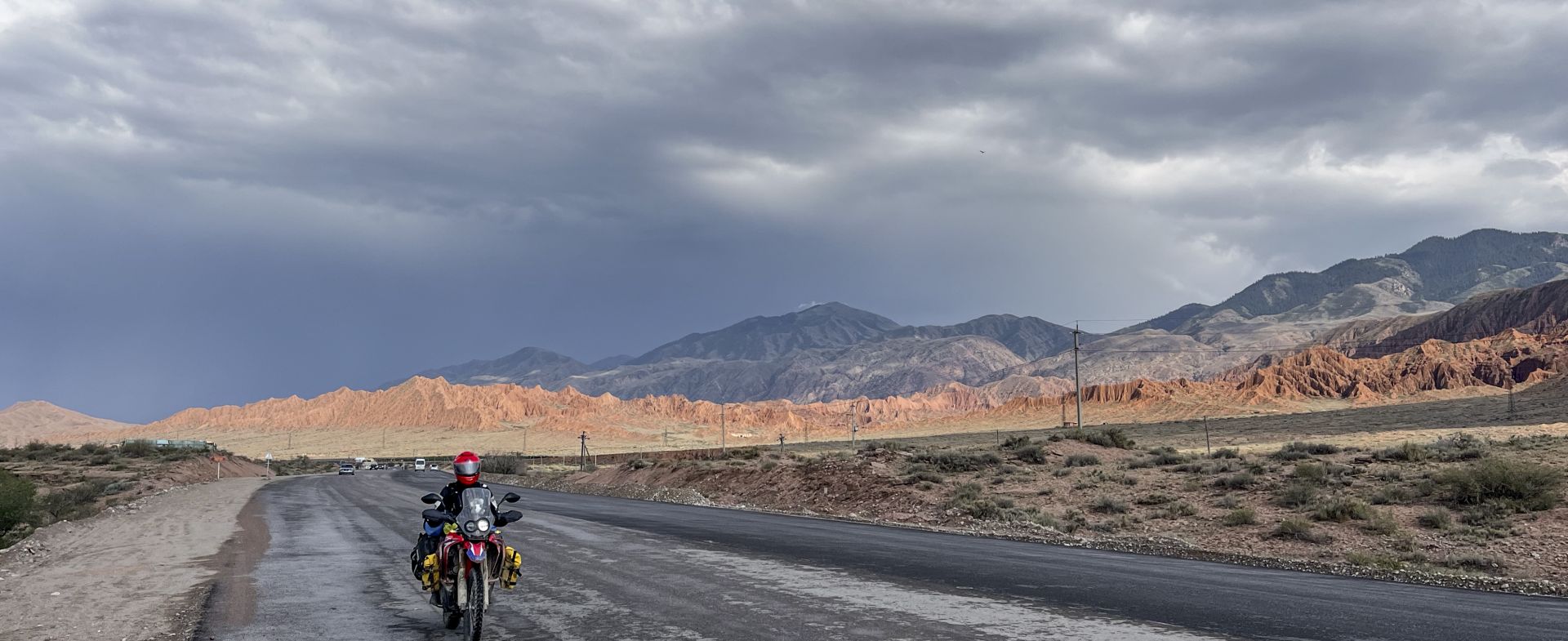
High notes on high passes - Part I

A Grand Tour of Kyrgyzstan, China, Pakistan, and Tajikistan

The waiting game

In 2007, photographer and biker buddy Trui Hanoulle and I spent seven months travelling through nine Muslim countries, covering 30,000 kilometres. As soon as I got home, I wanted to leave again. But life got in the way, as it tends to do. It’s never a good moment to leave. It took me close to twenty years to remind myself that one can just get on the bike and chase one’s dreams, for the sands of time trickle faster than you think.

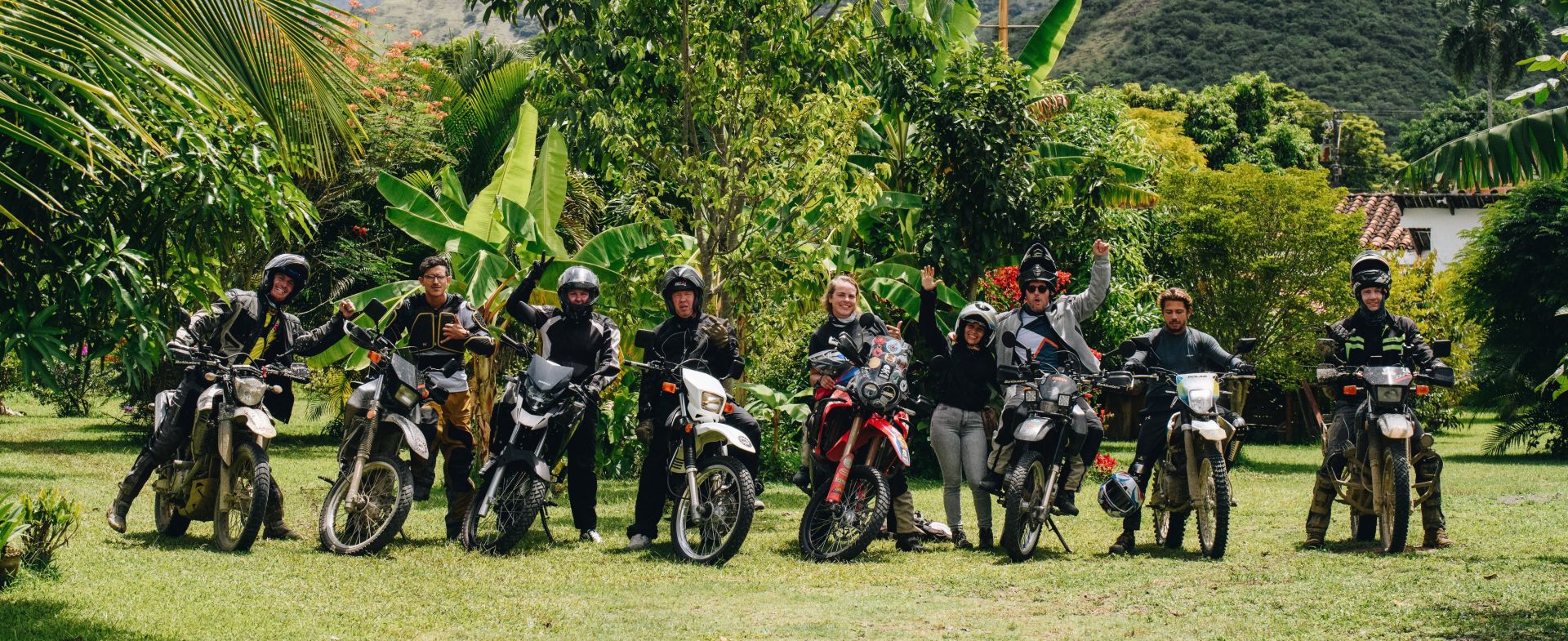
Hence Johanna and I bought two second-hand Honda CRF 250 Rally and shipped them to Kyrgyzstan by truck. Originally, we wanted to ride from Germany to Kathmandu, but the pressure on our schedules is high. Of the planned six months, only a hundred days remain, so we choose Bishkek to Kathmandu, an equally thrilling plan, especially since it is Johanna’s first long (motorcycle) trip. 

And Trui? She decides to fly in for the Pakistani part of the trip, because she wants to see how the country has changed over the past 23 years when she was last in the country.
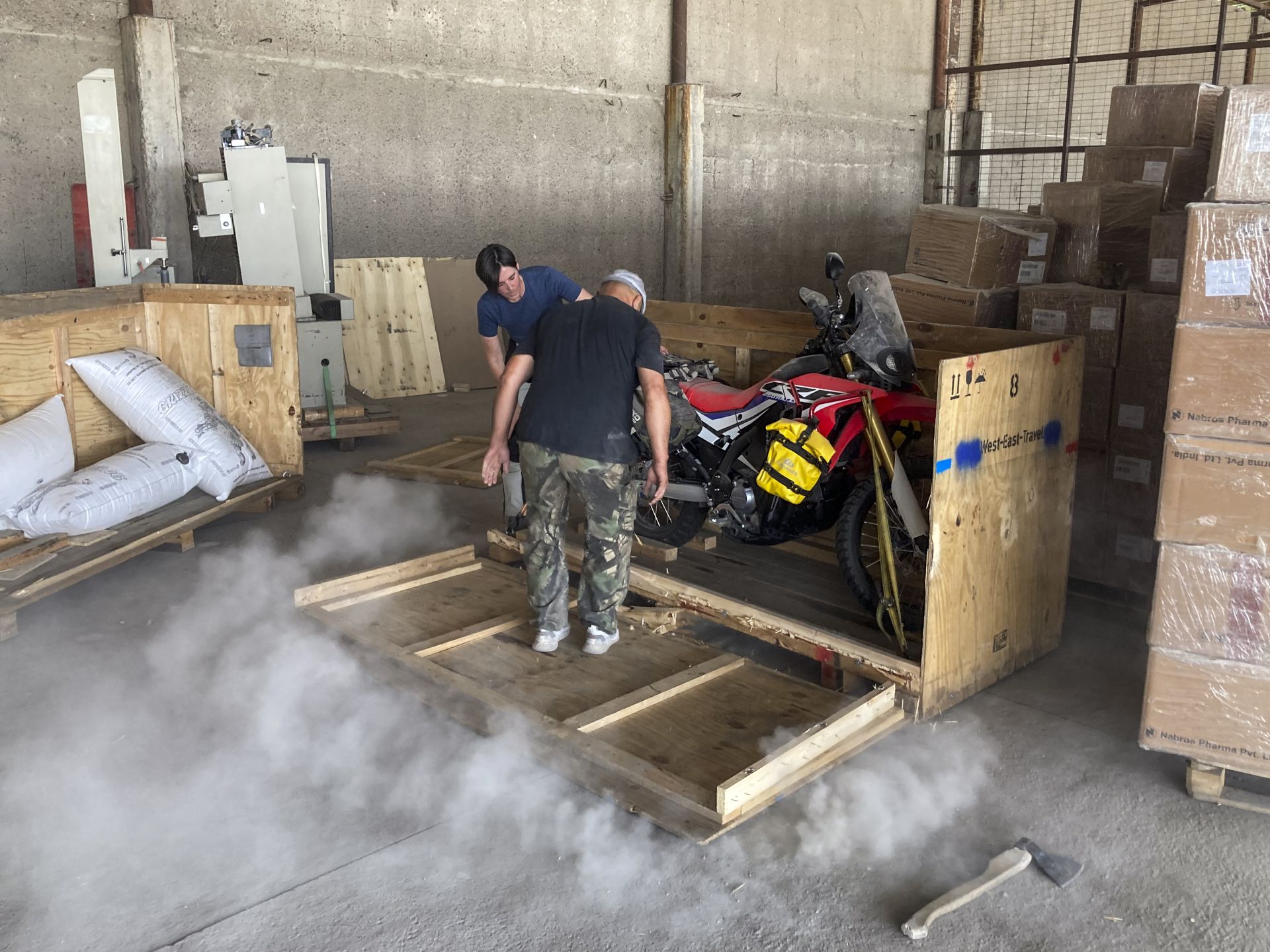
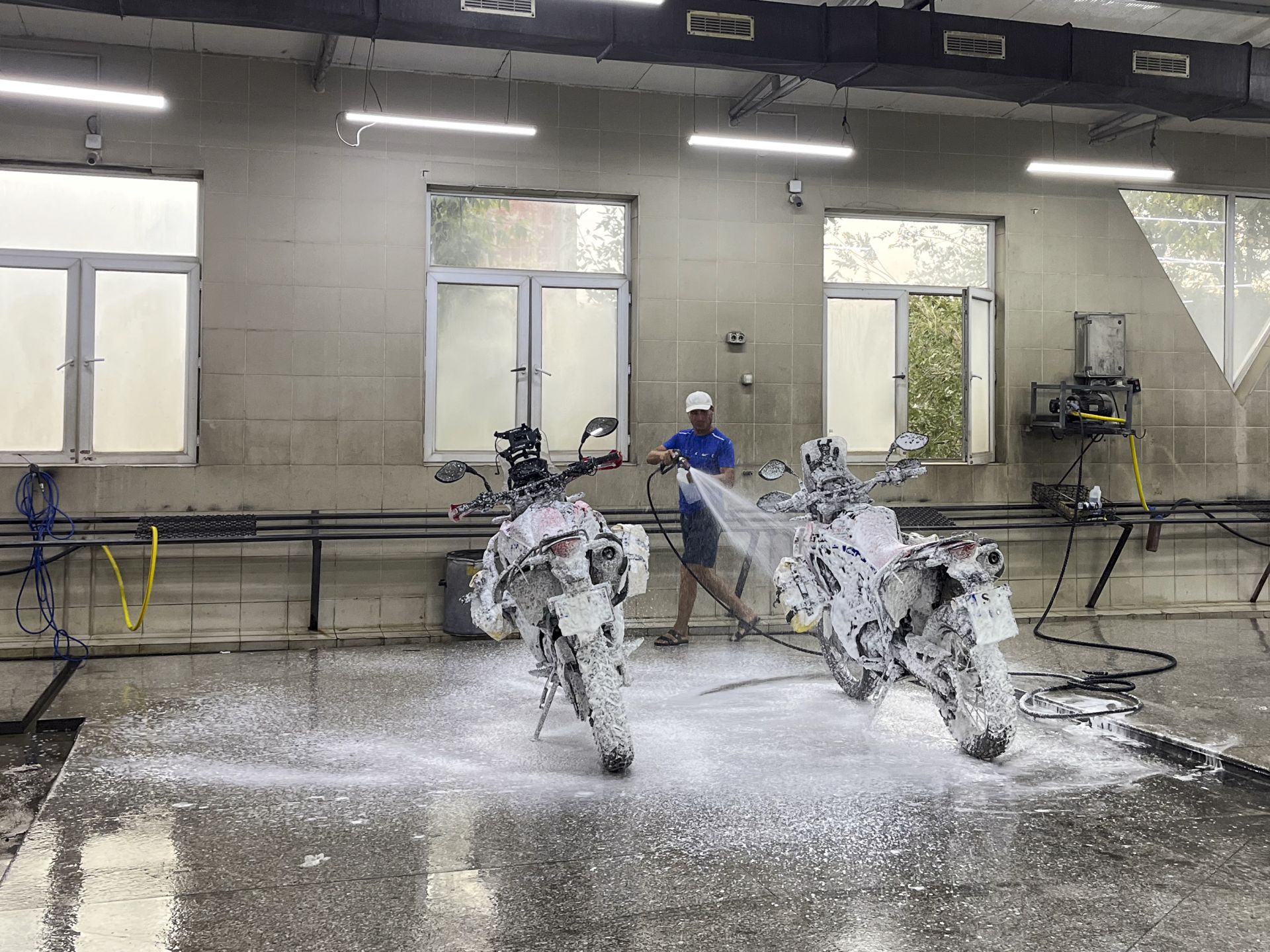
At the end of July, Johanna and I land in Bishkek. Our adventure starts ‘smoothly’, ignoring the fact that the toll cost for clearing the motorcycles sets us back 800 euros instead of the said 100. We settle in our B&B, anticipating our Grand Tour. Just as we are getting ready to leave for the mountains, bad news arrives: we have to pass by customs in Bishkek again two days before crossing the Chinese border. Swearing like sailors, we explain that is impossible. We want to ride to the Torugart border crossing to China via the Tosor Pass and acclimatize at altitude along the way. ‘Passing by’ Bishkek means a 400-kilometre detour. But there is no arguing, these are the new rules, end of story. No paper, no border. ‘Accept it,’ I say to Johanna. ‘That kind of hassle is part of this kind of journeys.’ So, we decide to spend a few days on the south side of Issyk-Kul, the largest lake of the country, and ride the Barskoon Pass at 3,819 metres, a suitable first altitude test for the little Hondas.

They handle fine, but in the final hairpin bends, Johanna’s bike runs short of breath. That bodes well: the Khunjerab Pass, the world’s highest paved international border, between Pakistan and China, is a good deal higher at 4,693 metres. Johanna on the other hand, a soprano by profession, has breath to spare, and cheerfully launches into an aria on the pass. The police officer who comes to check our papers laughs: ‘I sing too. I’m a baritone. A duet?’ It’s an odd place to hear Mozart, but a wonderful one too. 

Tinkering and tracking

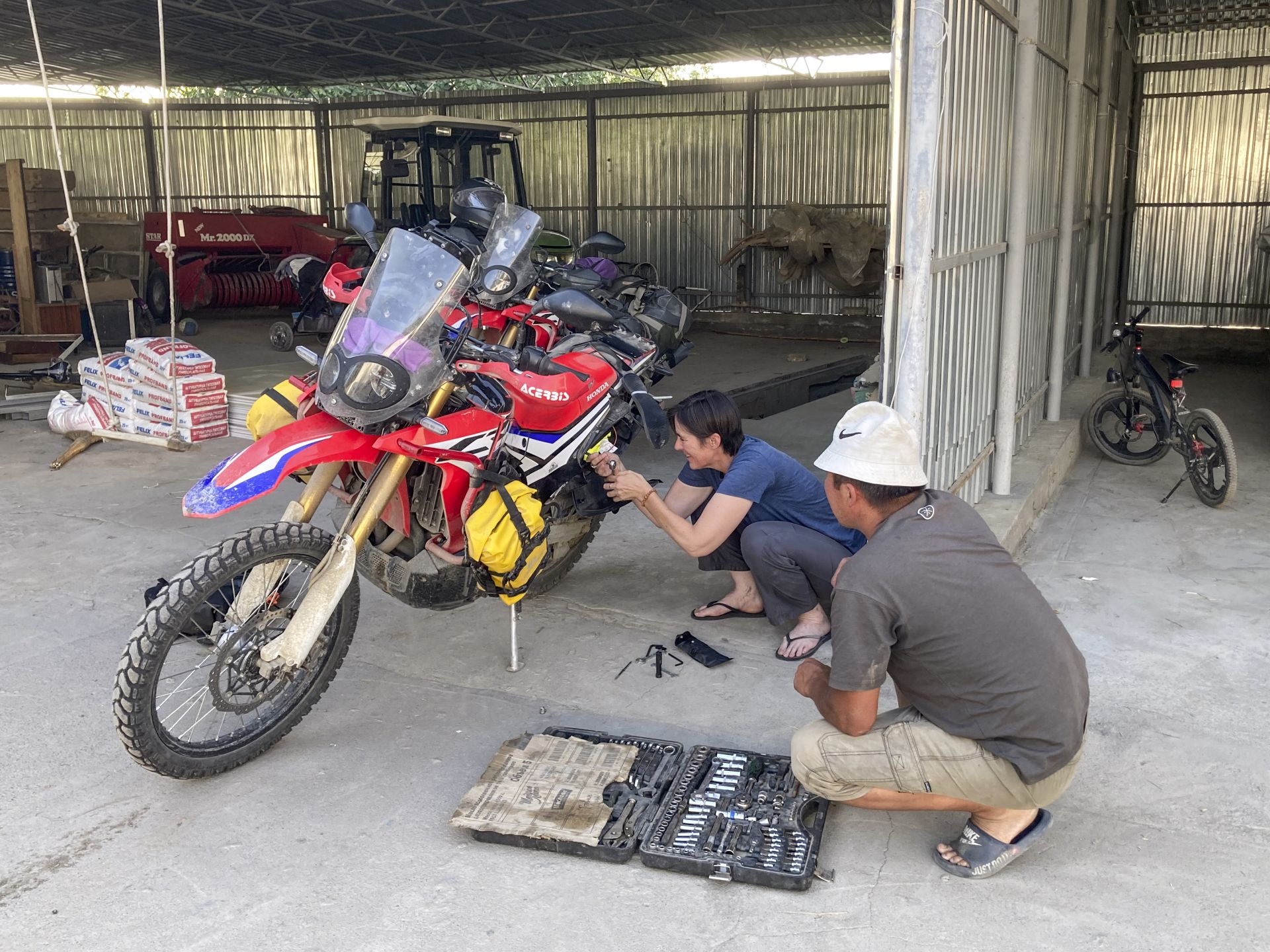
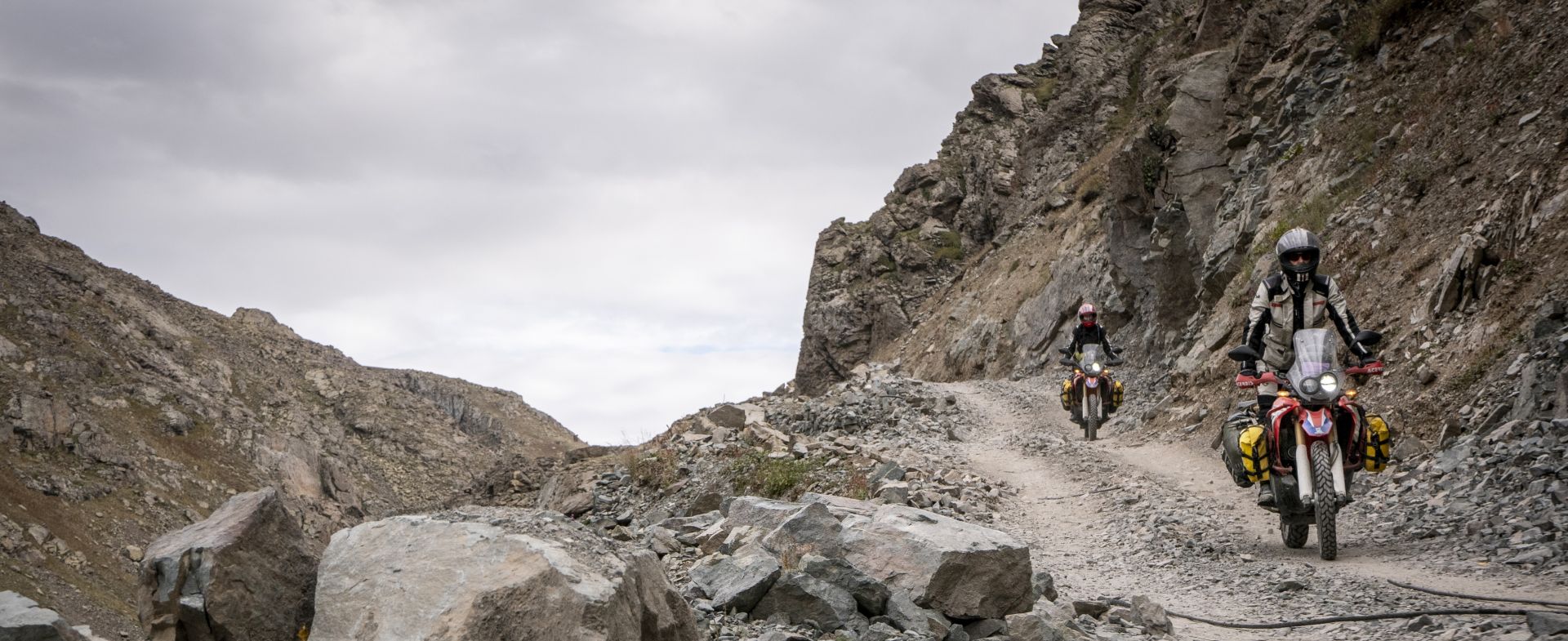
Afterwards, we explore a few side tracks that lead through spectacular gorges, and a high plateau as beautiful as it is desolate. A final, somewhat more technical track branches off towards the Tosor Pass. After some kilometres, the sandy washboard gives way to a comfortable trail that winds upwards between the mountain flanks. Not hard, yet gradually the stones get bigger. At one point, my front wheel gets stuck between two boulders. Throttling it out, seconds later I hear the engine roar. What!? Could it be that for the first time in 25 years of motorcycling, I have burned my clutch? When I push the bike onto flat ground and gently try, it’s obvious: the plates are slipping. Not funny, especially since we have a fixed date for crossing the border into China. Finding new clutch plates will be complicated enough as is, even without time pressure. I shift into second gear and roll the bike down. Out of sheer necessity, the tricky passages become a breeze.


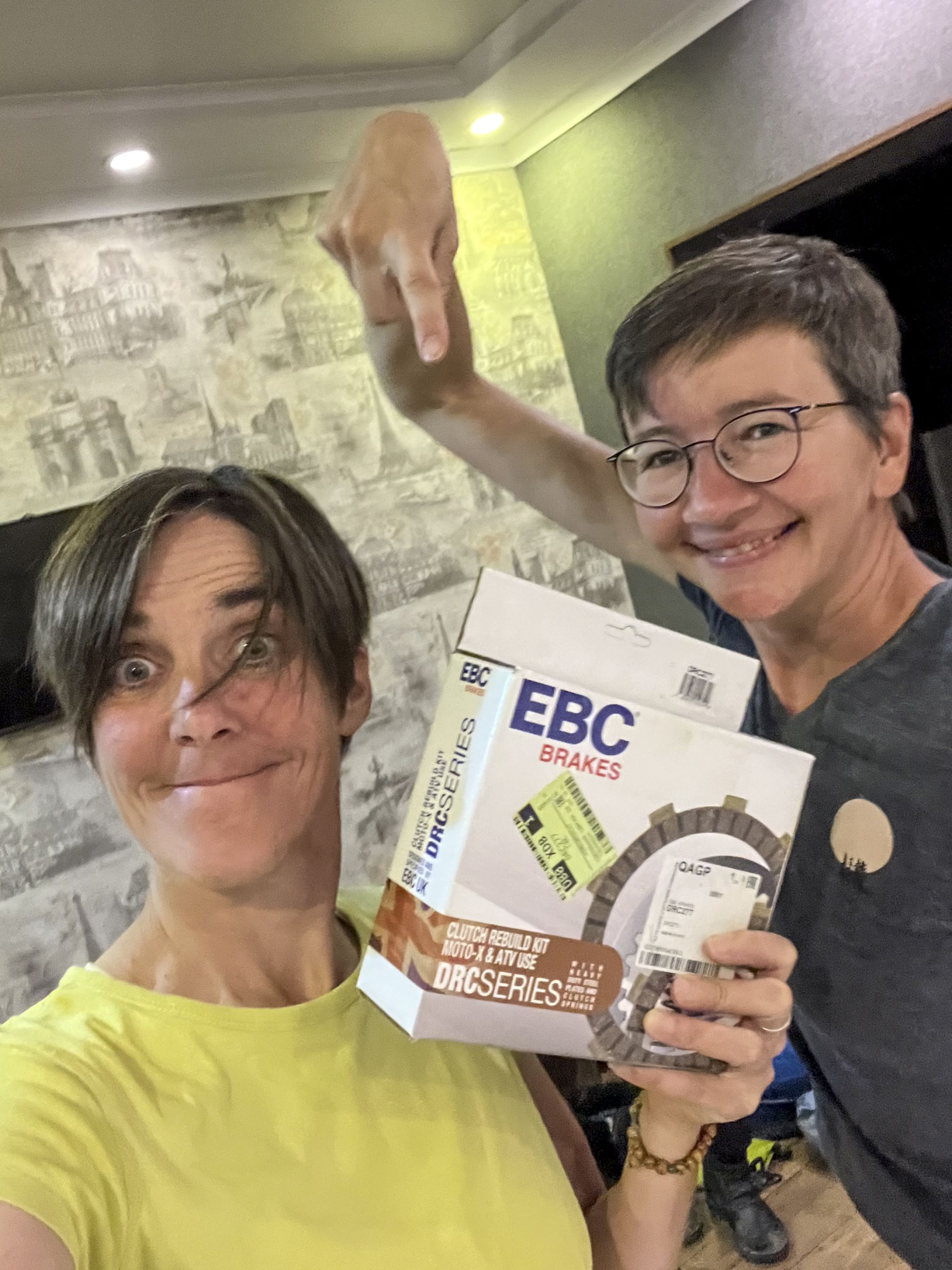
That evening at the guesthouse, after tinkering with the clutch cable tension, I get my bike back into a more or less usable condition. Thankfully, days later, a Polish motorbike tour organiser manages to find spare clutch plates. And by now, Trui has landed in Pakistan. One way or another, we have to get there.

Meanwhile in Pakistan — Trui’s story I

As I’m queuing for the airplane from Islamabad to Gilgit, the airport security lady summons me to the male line: ‘Sir, please this way.’ I chuckle, straighten up, sort of showing my tits. ‘I’m sorry, madam, I’m really sorry,’ she says startled. I have short hair for starters. I’m wearing biker boots and jacket, and I carry a helmet. Who’s to blame? I wink reassuringly.

Hours later, I take my Suzuki GS 150cc rental bike for a first spin around town. My muscle memory needs to get rewired as all five gears are down. I have the bike stalling and screaming in equal measure. Remarkable: even in the buzzing centre of Gilgit, traffic is less hectic and intrusive than in India, and less overall. 

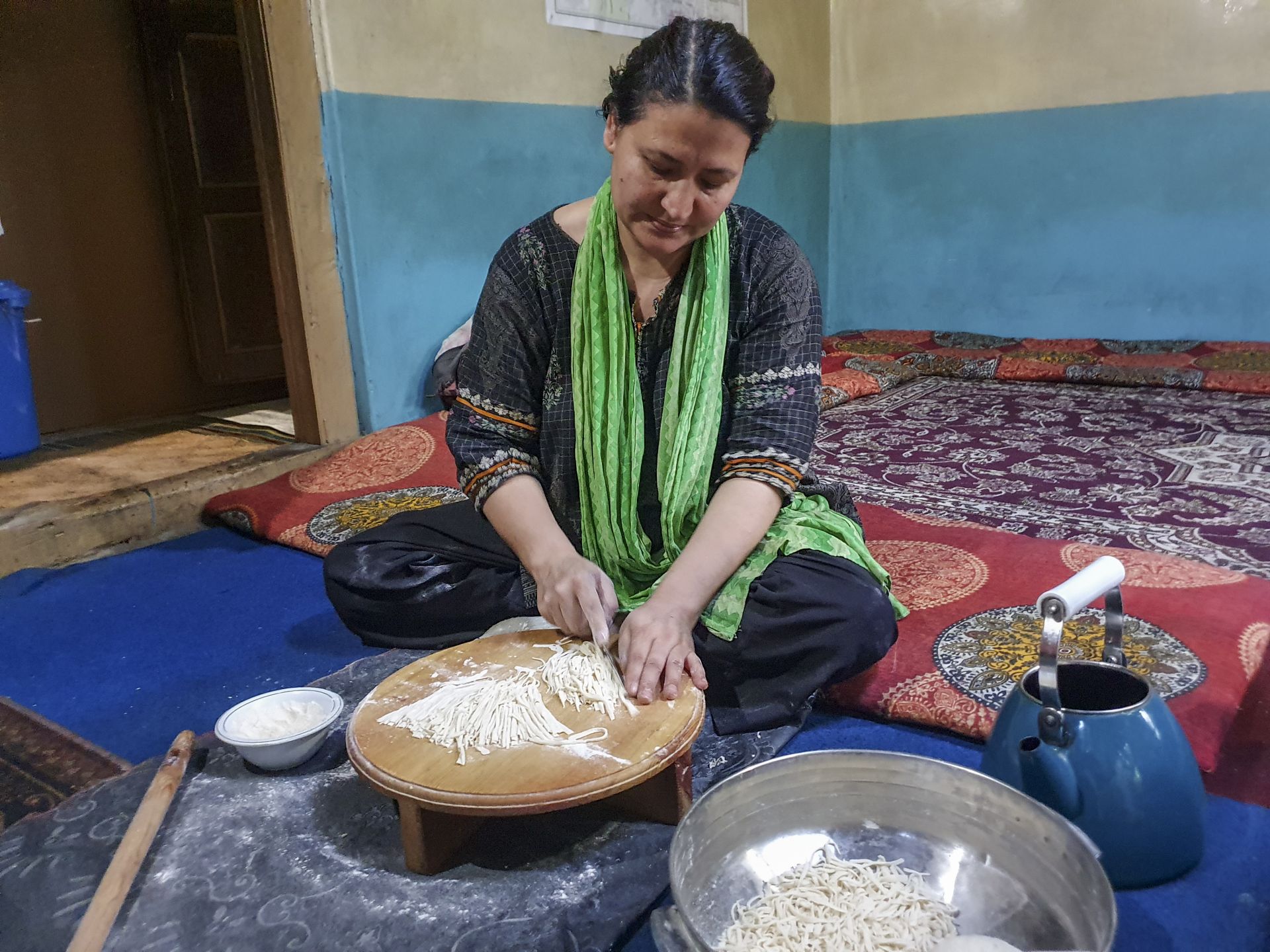
At the Five Giants guesthouse, I bond quickly with Meena and Shahin, the two women of the staff, helping them to make veg and chicken momo’s (dumplings) to their favourite Paki pop music.

It will prove to be a challenge during the entire journey to get to know women. Men run the guesthouses, the service stations, the checkpoints, the markets, the shops, everything; women run the homes and work in the fields, but time and again we will find ourselves for days amongst (friendly) men only.

While getting myself acquainted anew with the ins and outs of Pakistan, I keep following my friends’ adventures and setbacks.

A pile of mishaps

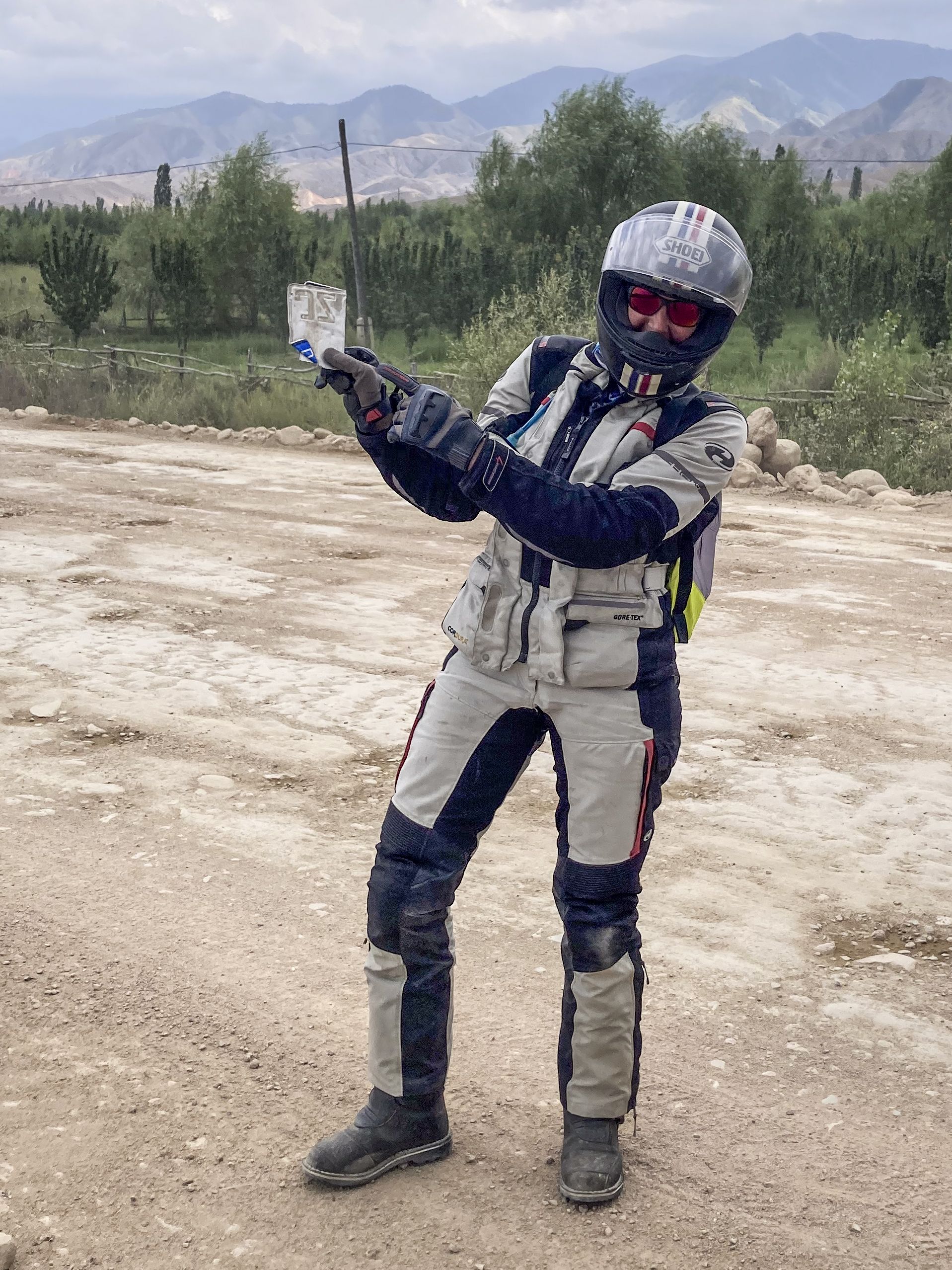
On continuous stretches of roadworks which the heavy trucks irrevocably turn into a washboard, Johanna and I ride back to Bishkek. By lunchtime, we are ‘shaken and stirred’. A man at a table next to us points to Johanna’s bike: ‘Big problem. Police.’ Due to all the rattling, half of her number plate has broken off. After searching for hours, I spot a blue bit sticking out of the dust: the number plate run over and neatly folded to the size of a pack of cigarettes.

Day after day, the mishaps keep piling up. And get solved, somehow. Customs demand a translation of our papers (urgent means a ridiculous tariff), escort to the border is compulsory (we sneak out of this one), the custom computers need days to function after an update (we wait it out losing three days). By now, we’re at mishap number 7. Johanna is going bonkers, almost ready to send the motorcycles back home, when the cork suddenly pops out of the bottle: we have to pick up the papers now, right now. 

Still, we are left with an uneasy feeling. Is this whole trip a bad idea after all? Trui who’s in Gilgit by now, laughs when I tell her. ‘Of course not. Be happy! Your bad luck must be over. From now on, everything will be plain sailing.’ Her optimism is refreshing, but when I ask how it is in Pakistan, it turns out that the entire south is groaning under the floods caused by the unusually heavy monsoon, landslides are blocking parts of the Karakoram Highway and the Skardu valley, and protesters are hampering the road between the border and Sost. ‘It will be fine,’ she cheerfully adds.

Finally on our way, we head to the ancient Tash Rabat caravanserai. In 2007, the place was deserted; now, tourist yurts and wooden cabins are everywhere, and small vans disgorge groups of day tourists. Fortunately, at night, silence flows over the valley and stars fill the sky. The camp is still asleep when we set off for the border the next morning. Horses startle as we ride past and run alongside on the gravel track, but as soon as we turn onto the main road, the romance is over. A brand-new asphalt road winds upwards between the snow-covered peaks, and kilometres before the border, bumper to bumper, an endless line of trucks stands waiting. We ride past in a hurry, as we must be in China before the border closes. In the customs office, we are shuffled from desk to desk like a hot potato, until the highest-ranking official takes our papers with an eye roll, stamps them, and pushes us out the door. 

Check, double check, triple check

Through no man’s land, we chug towards China. Three days we will need to cross the country, on the first leg of the legendary KKH that I had yearned for so much, accompanied by a guide and driver, with a Chinese driver’s licence and numberplate (obligatory for foreign vehicles), all of which comes at a hefty price.

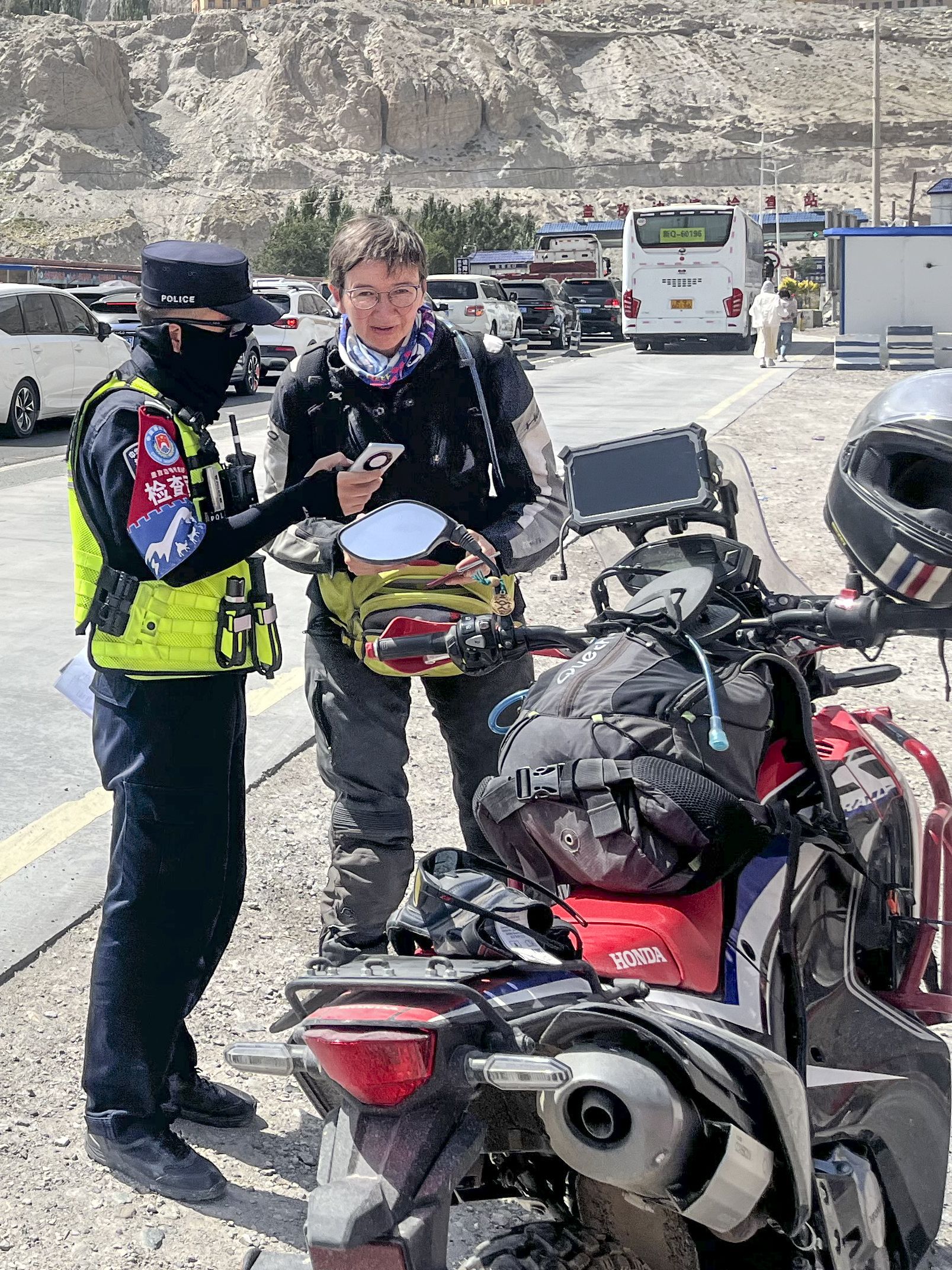
First our luggage has to go through a scanner. The motorcycles are scanned too, because that is the procedure for trucks, so it applies to all vehicles. While we run back and forth with bags and sacks – quite tiring at nearly 4,000 metres – our passports are checked at least ten times. We could easily have morphed into someone else, unseen. Then Hedy, the guide, shows up. Not that it makes things any more relaxed, now we’re really being bossed around. The real customs check is yet to come, a hundred kilometres onward. ‘Follow that car!’ Hedy summons. Sounds simple but the driver drives like a madman, as does all traffic. By the time we arrive in Tuopa, Johanna is exhausted. She has much less experience than I do, and riding in this traffic requires complete focus. Once again everything goes through a scanner: the luggage, the motorcycle, and us. The body search, in full motorcycle gear with protective gear, is hilarious. Hedy smiles contentedly: ‘Very smooth and fast today.’

China reveals itself as a country obsessed with control. After someone spends an hour explaining Chinese traffic rules to us (which no one follows) and asks (but does not check, because the answer is clearly ‘no’) if we carry a warning triangle and a fire extinguisher, we are given a Chinese driver’s licence, Chinese number plates (virtual), and a mountain of paperwork. Once on the road, we run into checkpoints all the time, and as soon as we ride for even five minutes without our guide, we are pulled over. The checks proceed sluggishly. The officers wearing bodycams are stressed because they too are being controlled, and because all communication goes through a translation app, things tend to escalate due to misunderstandings. But hey, we’re in! And that’s about time, because at the other side of the border, Trui is already on her way North.

Preparing the nest — Trui’s story II

From afar through messages and images, I have been following my friends’ adventures and mishaps. After days of them being stuck in Kafkaesque red tape in Kyrgyzstan, they finally made it into China, meaning in three days they will reach the Paki border. 

After picking up my Suzuki GS 150cc rental bike from Karakoram Bikers in Gilgit, with a hop-step-and-jump in Hunza, I aim for Passu, getting ready to meet up with Gaea and Johanna. Gradually I climb through the mountains towering higher and higher, from 1,500 m to 2,500 m, on the Karakoram Highway, the KKH, the main artery of Northern Pakistan and one of the world’s most legendary roads. 

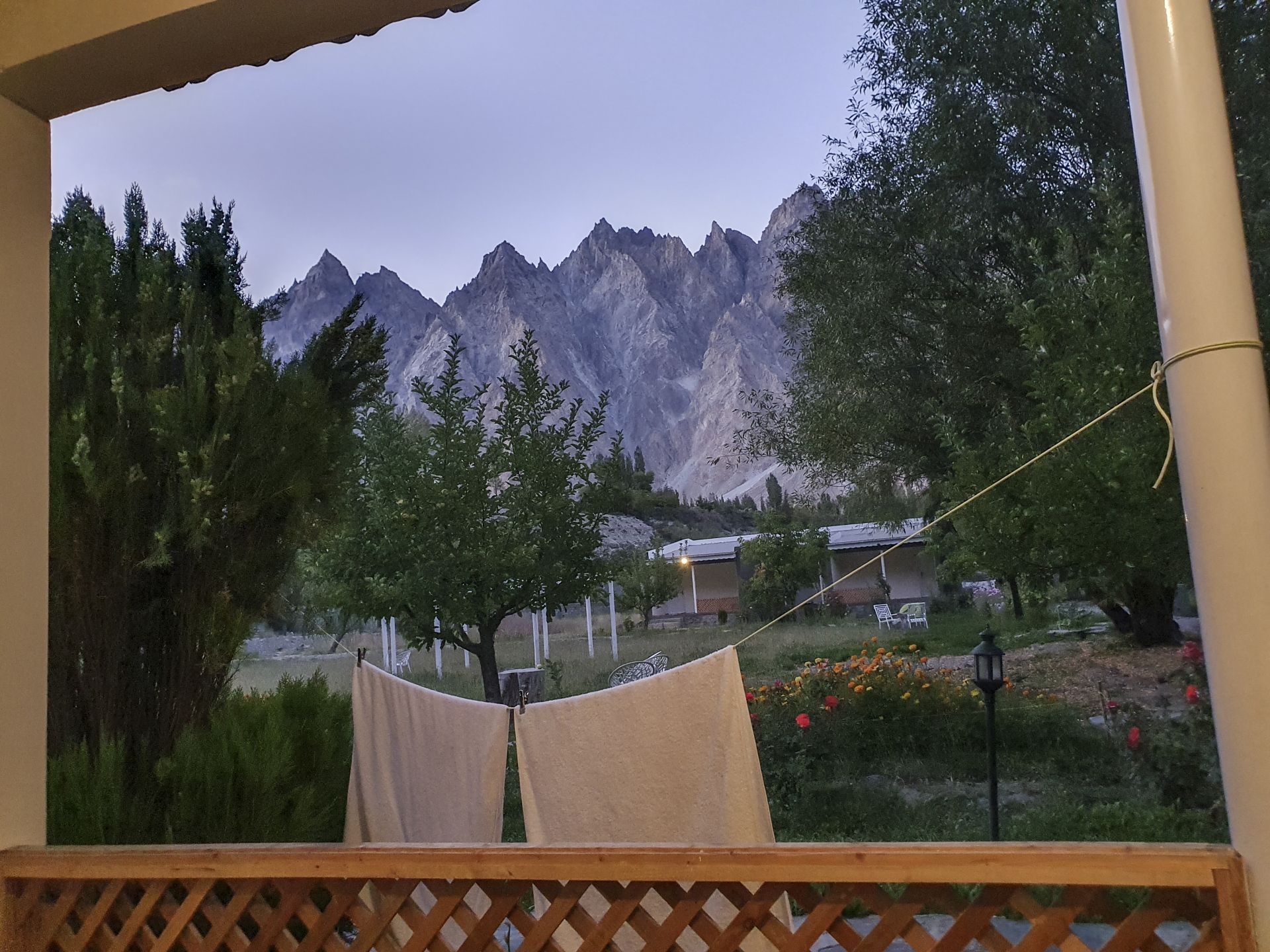
As I round the last corner, the majestic valley opens to the jaw dropping Passu Cones, and the message “WELCOME TO PASSU” set in white stones on the rock face, like I remember it from 23 years ago. I stop. I watch. A gush of sheer joy fills my body. No image can do them justice. Just too grand. Also known as Passu Cathedral, their local name is Tupopdan, meaning ‘Mouthful of Sun Mountain’. The rock wall stands at 6,106 m, so from my bike saddle it’s a 3,6 km upward view.

I ride on, my eyes glued on the giants, the KKH now gliding down next to the broad river. At the outer edge of the village, I find the spacious Passu Tourist Lodge facing the Cones. The place is simply perfect as our soon-to-be home base. Because of the view from the portico, the well-tended garden with blooming roses, the perfect room, and even more so because of the welcoming owner Ummad, his father Shah, and staff members Dannish and Amin. We’re all ready for my friends’ arrival. Soon a new chapter is bound to begin.

Across the border

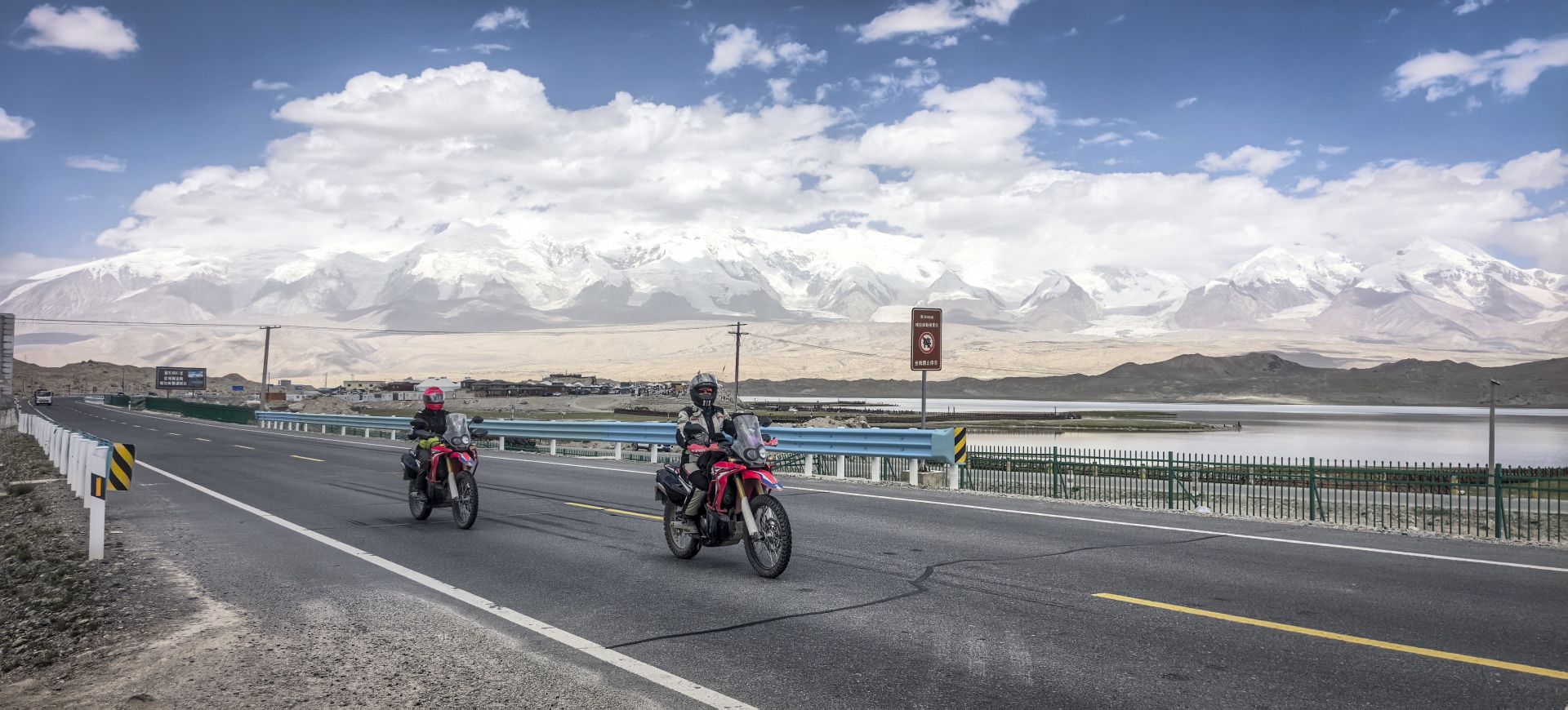
From Kashgar, Johanna and I head towards Tashkorgan, a ride as magnificent as it is tiring. The altitude is making itself felt and the driver only stops once, at the official viewpoint at White Sand Lake. There, for a fee, one may walk along a constructed wooden path to the viewpoint. That’s as far as the freedom of movement goes. The Chinese don't seem to mind. The owner of the white yak with whom they can take a selfie, is doing a roaring trade. We find it nuts. We ride on southwards, while the mountain peaks around us become increasingly higher and barer. But the desolate experience I had hoped for turns out to be an illusion: it is just short of being gridlock all day long. The next day towards the Khunjerab Pass is no different, for there is tension between the neighbouring countries, and so the Chinese flock to the border in droves to sing patriotic songs.

For the last stretch, after another series of unloading-scanning-loading-unloading-scanning-loading, our motorcycles are fitted with an electronic seal by customs, the kind used for trucks. As if I could hide something or someone in my luggage. On top of that, I have a bodycam strapped onto my jacket, because on the 100-kilometre stretch between Tashkorgan and the border, where the guide is not allowed to accompany us, it’s forbidden to take photos or stop. We don’t take it seriously, until I stop to put on a sweater. Above 3,000 metres it cools down rapidly. Promptly, the thing starts shouting in Chinese. Nuts once again. But this ride is dazzlingly beautiful. The road winds ever higher through a rolling, green landscape. A herd of Bactrian camels crosses the road, yaks graze everywhere. At long last the famous white gate looms at the horizon: the Khunjerab border crossing. We made it! 

Fifty metres further on, in an entirely different world, separated from us by two fences, and eight thousand kilometres away from home, I see a familiar face: among a group of men, Trui is waving frantically. Just one more stressed Chinese officer, two more stamps, and then the gate swings open. A broadly smiling Pakistani border guard waves us in: ‘Welcome to Pakistan, my friends!’

Text: Gaea Schoeters & Trui Hanoulle

Images: Gaea Schoeters, Trui Hanoulle & Johanna Zimmer


To know more about Gaea Schoeters go to:

https://www.gaeaschoeters.be

https://www.instagram.com/gaeaschoeters


To know more about Trui Hanoulle go to:

https://truihanoulle.be

https://www.polarsteps.com/TruiHanoulle

https://www.instagram.com/truihanoulle


#FORYOURRIDINGPLEASUREONLY


Mehr Geschichten

It’s Not the Destination… Or Is It?

It’s Not the Destination… Or Is It?

Pumwee on Wheels part II - Mauritania

Pumwee on Wheels part II - Mauritania

Pumwee on Wheels part I - An adventure through Africa, into Europe...

Pumwee on Wheels part I - An adventure through Africa, into Europe...