
Almost twenty years ago, in 2007, writer Gaea Schoeters and I rode for seven months through Iran, Central Asia, Oman, and Yemen. Now I’m meeting up with her and Johanna at the world’s highest (paved) border for a journey through the country we left “for later” back then: Pakistan and its magical Karakoram Highway. I myself was there in 1999 with my then-girlfriend Iris, when an accident cut short our first overland journey, and again in 2002. Eager to be back in the country and meet more of its warm-hearted people, I didn’t have to think twice when Gaea and Johanna invited me to join them for the Pakistan leg of their Grand Tour. Flying in, renting a bike, meeting them on the Khunjerab border – it’s dead simple.
High notes on high passes - Part II
Motorcycle Diaries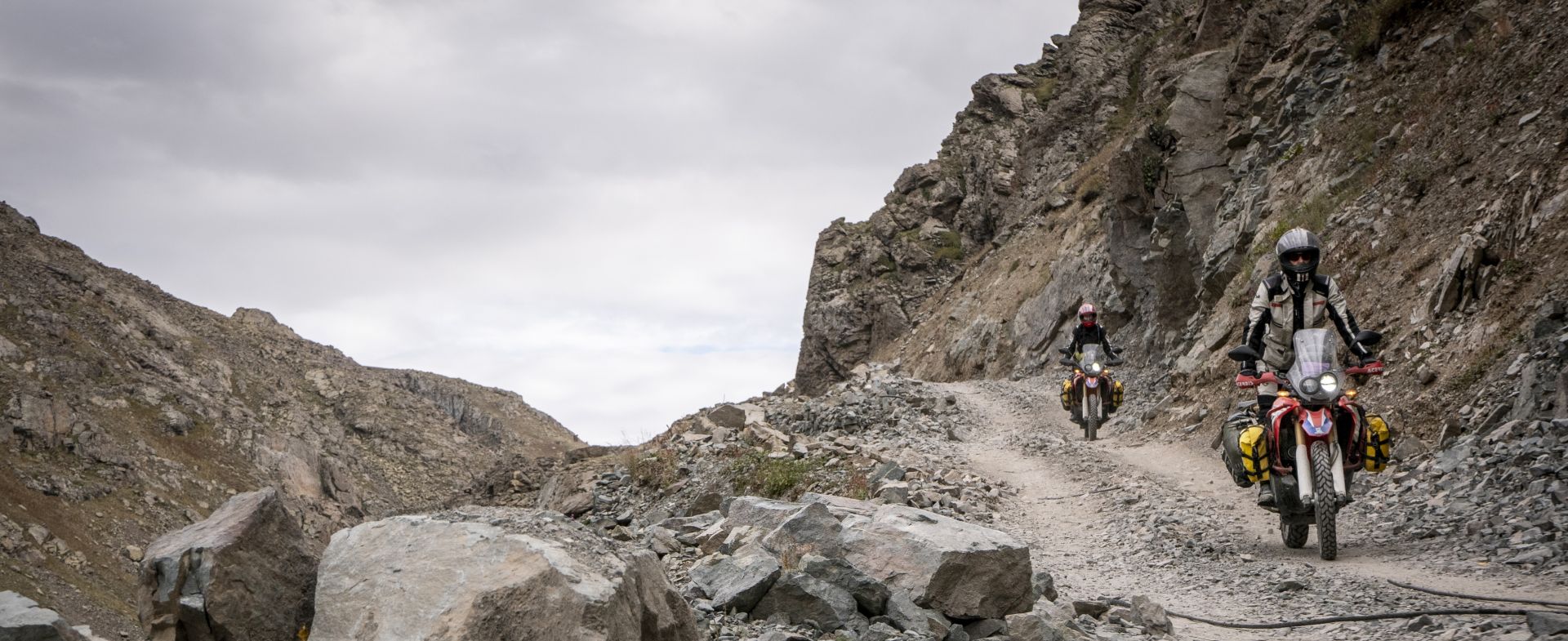
A Grand Tour of Kyrgyzstan, China, Pakistan, and Tajikistan
Pakistan with a big smile

Two tiny dots
I wake up before the alarm, have a quick breakfast and ride. From Passu it’s a 120 km stretch up to the border on the Khunjerab Pass at 4,693 m. At the entrance of the National Park, I pay the entrance fee, take out the air filter to help the 150cc Suzuki GS cope with the height, then continue to the pass. The real climb, covering the final 1,500 metres of elevation, takes place in the last 15 km. Devoid of traffic, I have the mighty KKH all to myself.
Once on the plateau, the famous, huge white gate looms into view. I walk to the border fence, watch and wait. Ten, twenty, forty minutes. Finally, two red dots appear. They made it!
Excruciatingly slow, the Chinese check their papers, then unlock the fence. The Pakistani border guard walks up to them and excuses himself for checking their passports. Then, with a huge grin, he adds: ‘Welcome to Pakistan, my friends!’ The two bikers ride into my arms. Screams, dances, laughs, hugs, tears, helmets off, more hugs, more tears. The border guard is as happy as we are.
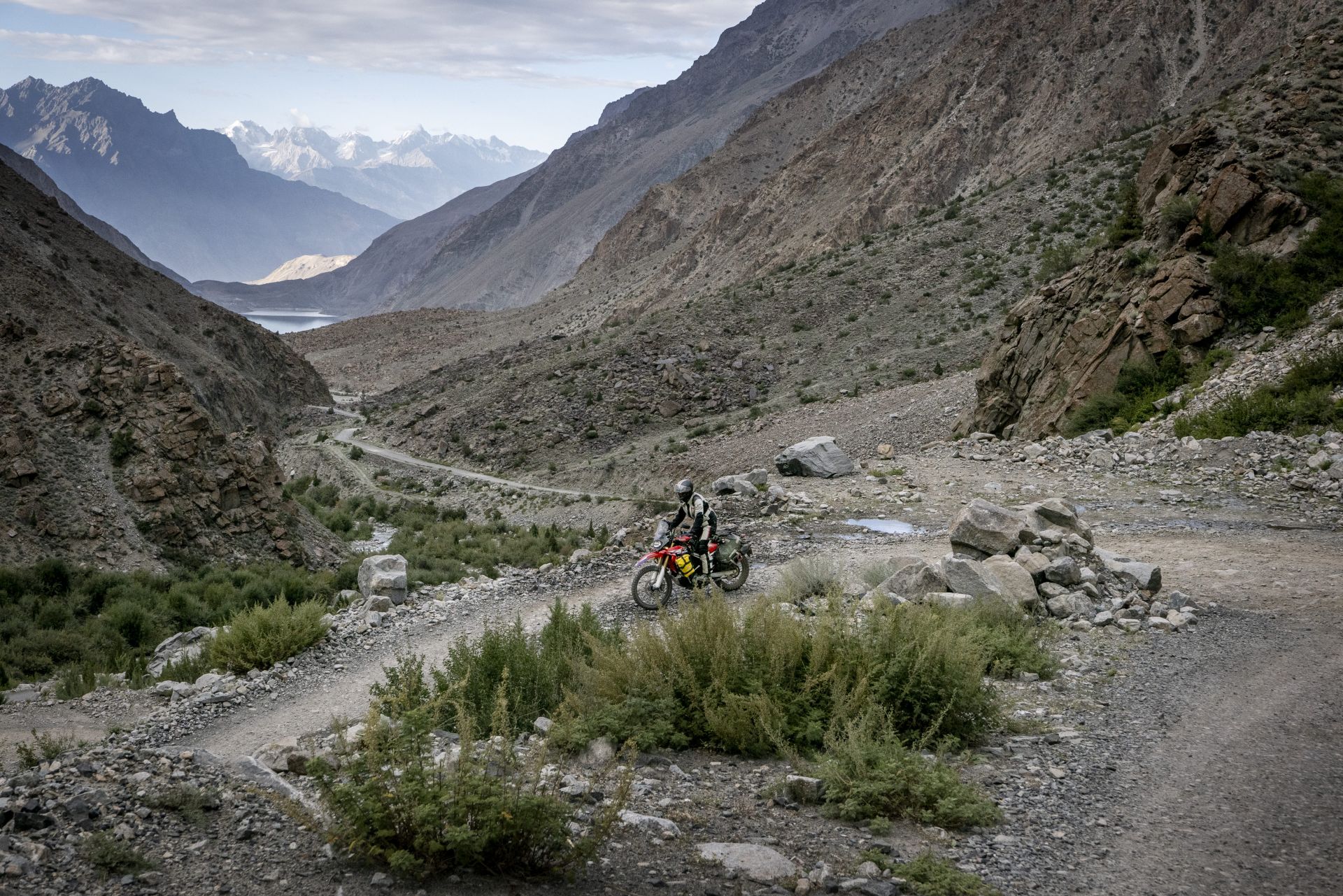
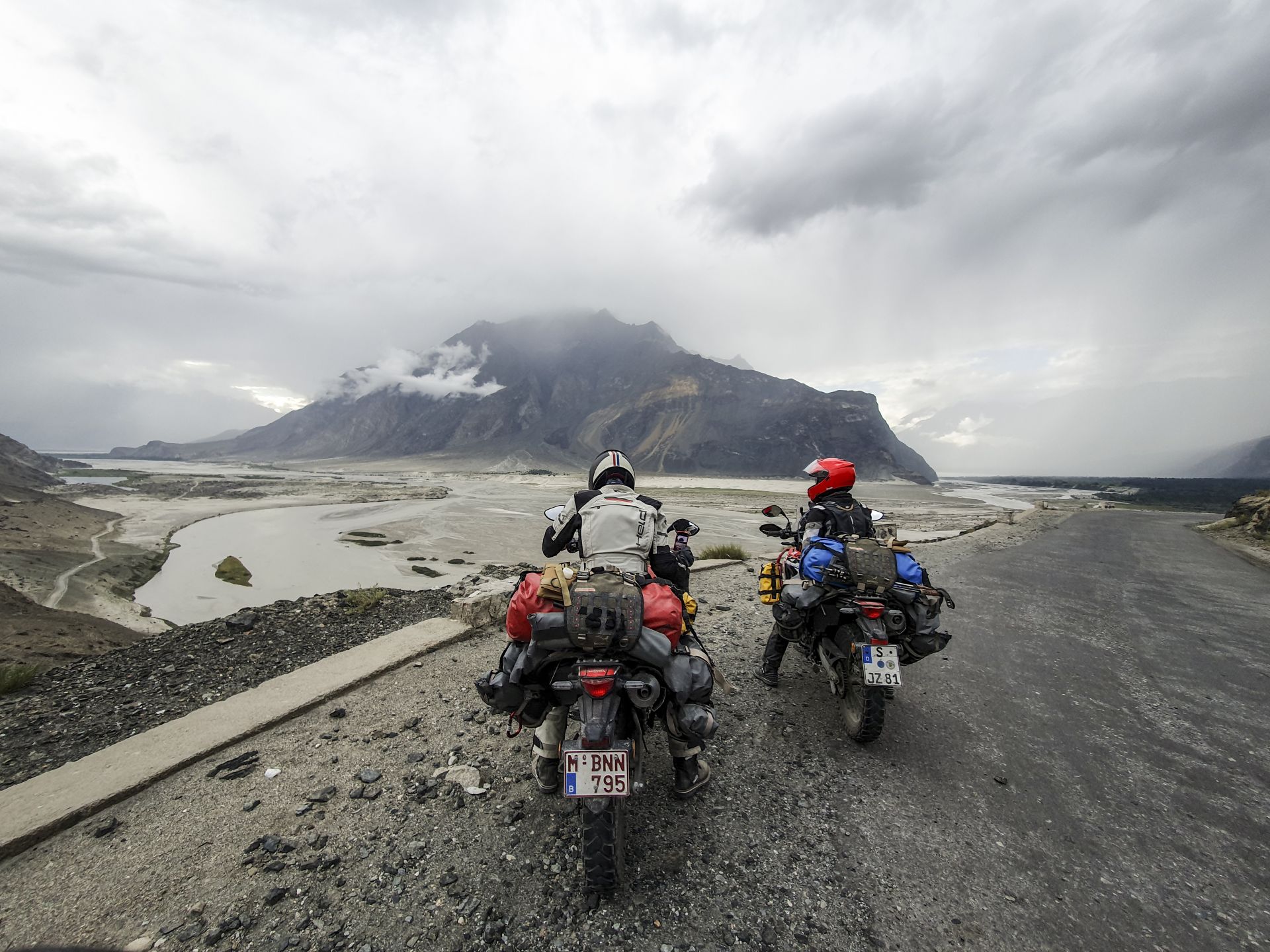
After a myriad of pictures, we zip up our jackets and ride. Not any more sublime entrance into a country than this dazzling, winding road down through the empty, barren, high-altitude canyons. The curves eventually join the roaring Khunjerab river, almost pitch black. We stop to watch, mesmerised by the whirlpools sucking everything into its depths. It's dizzying. Harrowing. Only later we understand what this means.
In Sost the customs paperwork takes a while, however it all comes with tea and friendliness. Eventually we can ride on to the lodge. We sink down in the chairs, tea at hand, chatting. The last sunrays warm the silent, baffling Passu Cathedral.
The melting mountains
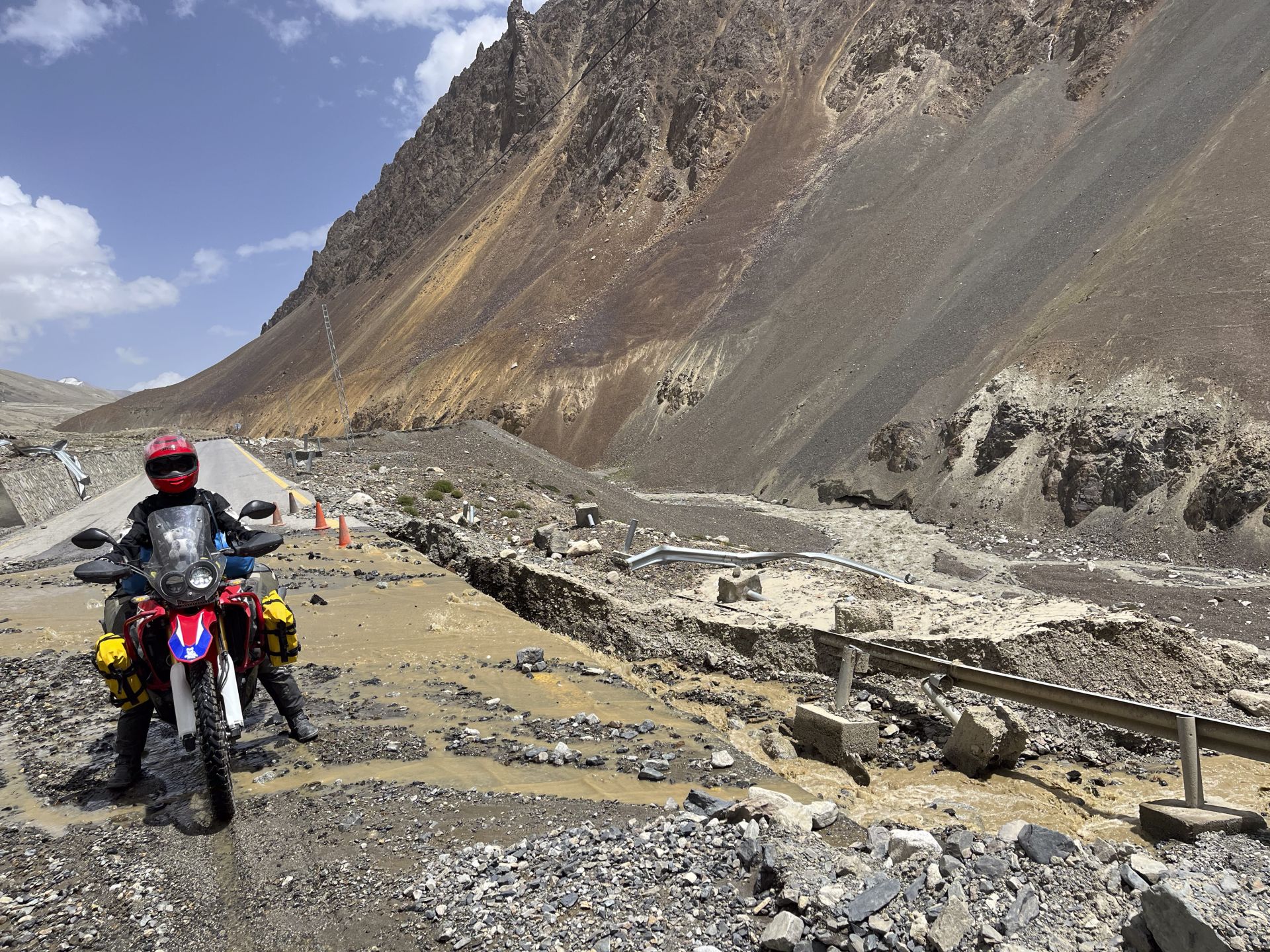
The next morning, we spread out the map and plan “our” Pakistan. Suddenly, news comes in: yesterday, some 15 km South in Gulmit village, a bridge of the KKH has been swallowed by a flash flood, a Glacial Lake Outburst Flood or GLOF. By an incredible stroke of luck, no-one got killed or even hurt, but land, orchards, electricity and internet cables, a well-known restaurant, and a few houses have been washed away in seconds. We ride down to see for ourselves. The damage is the size of a football field. Massive boulders too big for any machine, large trees, all sorts of debris, and thick sludge in which one sinks knee deep. As this is the main road, the repair should be done in days, but now one cannot even walk across, and wading the raging river is obviously a no-go.

We’re stranded. At least we are together and we’re not in a hurry. We have a room with a formidable view and food within reach. Internet access is solely available 10 km South on a hilltop. Once a day we ride down and connect to the outside world. “Ride to the signal” becomes a thing.
But the mountains around us are crumbling. No wonder the river was black upstream. Climate change up close. This year, due to the heat being some 10° above normal, not only is the level of the rivers extremely high because of the rapidly melting glaciers, but it also causes rocks to slide all over.
We will see it throughout our journey in Pakistan: the restaurants and cafés and guesthouses, normally catering for a solid stream of tourists, are empty. Local tourists don’t come after the floods in Swat killed hundreds, and the foreign groups cancelled due to the Kashmir crisis between Pakistan and India. We never need to book in advance, and everyone has time for a chat, but for the local inhabitants it’s a disaster, not just for tourism as an indispensable income, but even more for day-to-day life.
Deosai Plains
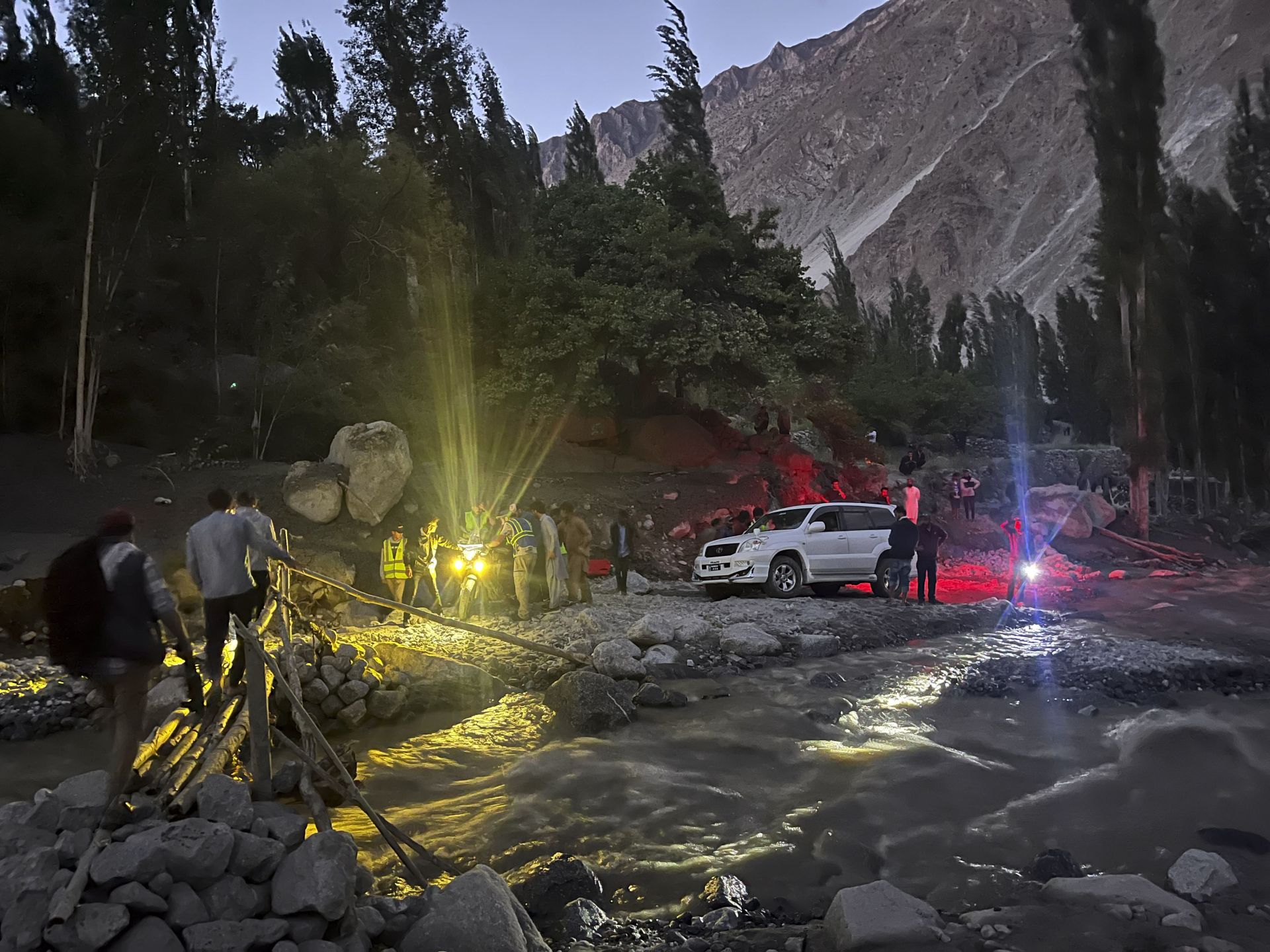
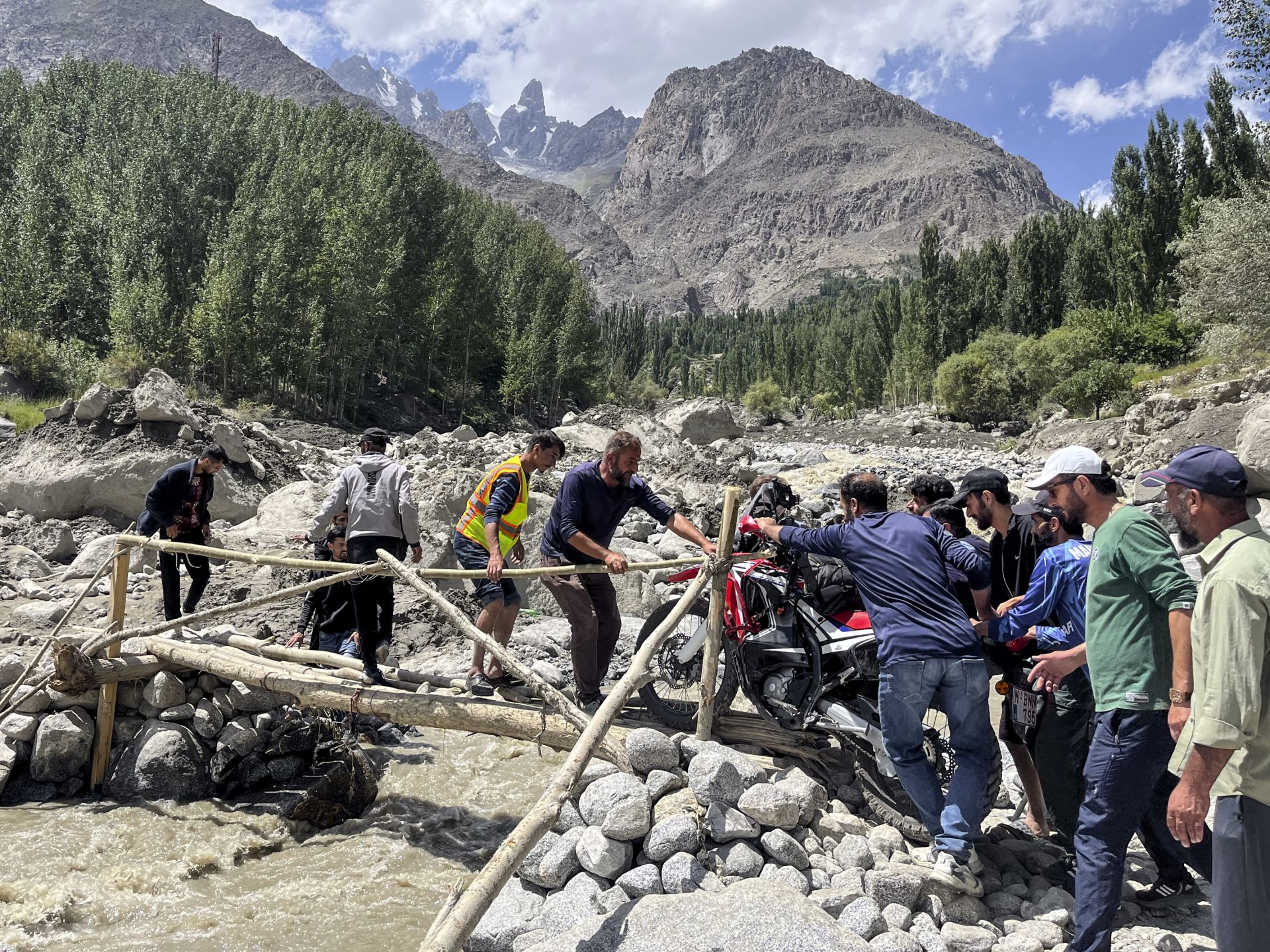
At the lodge, we are told we should leave as soon as possible as loads of debris is still up, ready to come down any moment. So, we pack our bags and ride down to the flood site. A group of volunteers heave the bikes across the boulders and a makeshift bridge, constructed for people on foot and small bikes. By now it’s clear this bridge is not getting repaired for larger traffic any time soon.
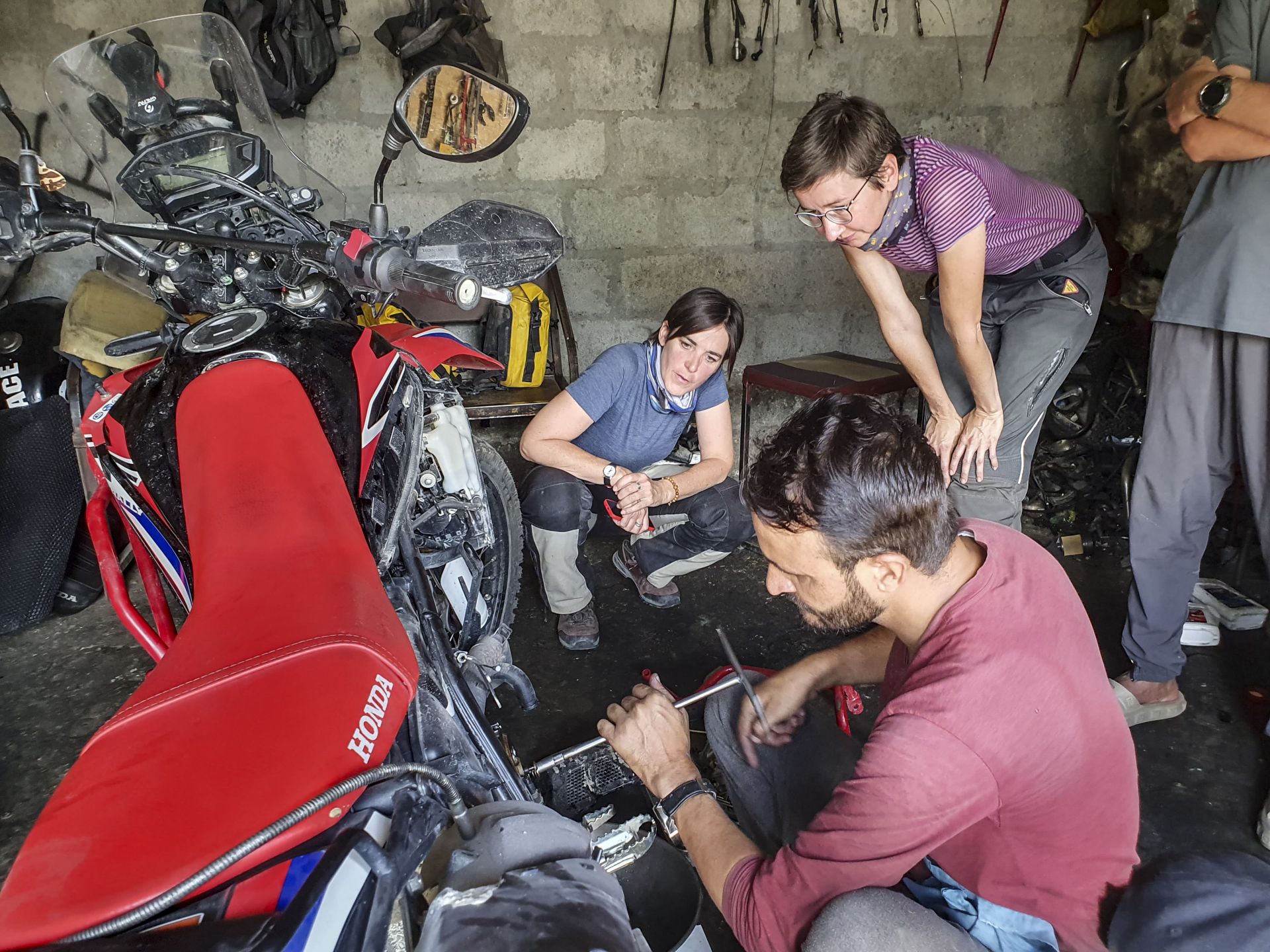
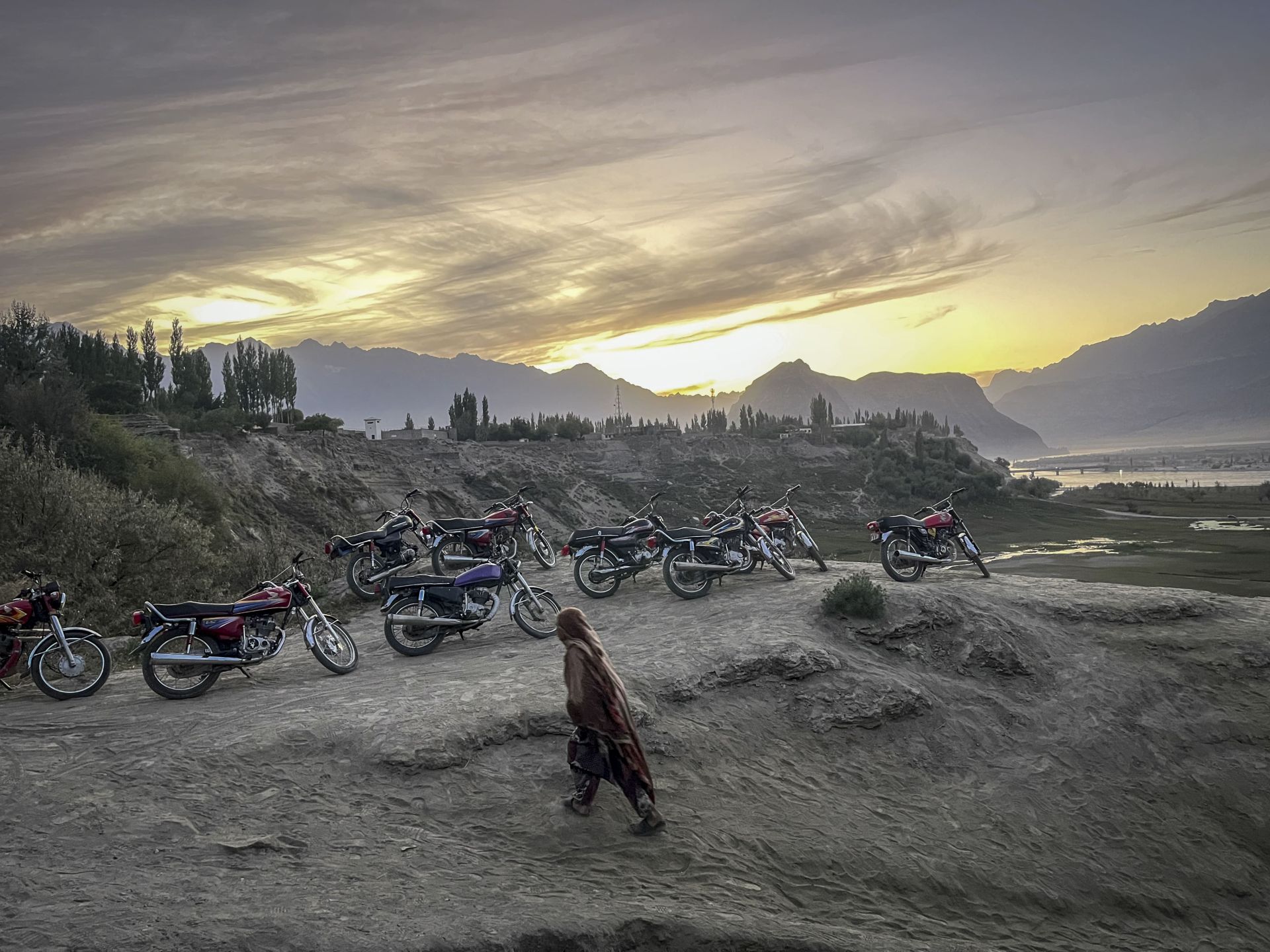
For us, our Pakistan journey can start to roll. After a week in Hunza and Gilgit where the gals have their clutches replaced with the spares, we continue to Skardu, Shigar, and Khaplu, exploring a few side valleys, and back to Skardu, before setting our eyes on the legendary Deosai Plains.
23 years ago, the Deosai Plains, a high-altitude nature reserve at an average height of 4,100 m, was one of the top things Iris and I wanted to see in Pakistan. However, the scarce information we had, was that it was a very challenging ride. Steep, narrow, rocky tracks with hairy hairpins and deep drops. We didn't go.
All of this was probably true back then, but now Deosai has become an important tourist destination, and the track became doable, so our guesthouse host assures us. We’re not convinced, but we ride without luggage and we’re in three. Let’s try.
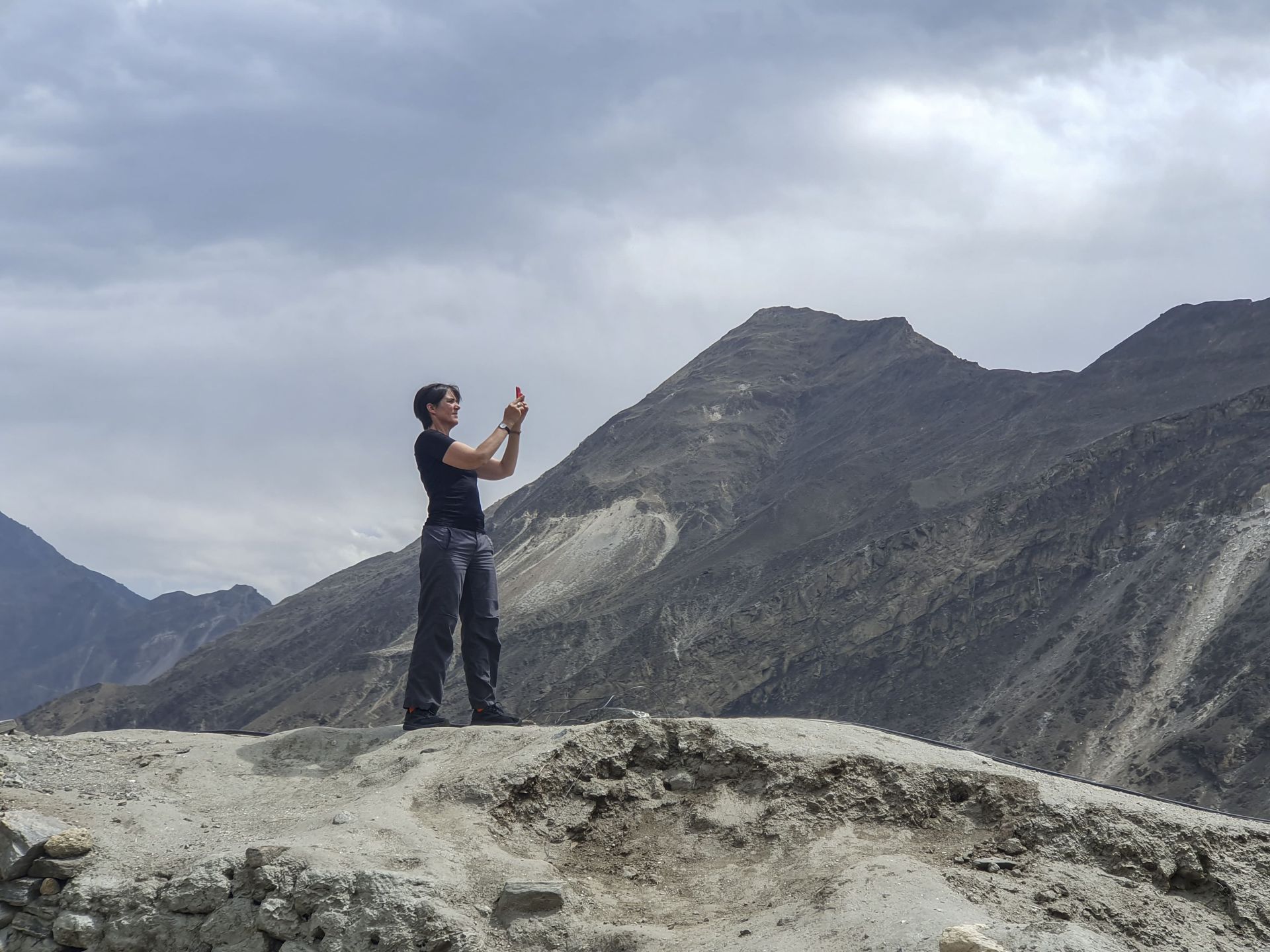

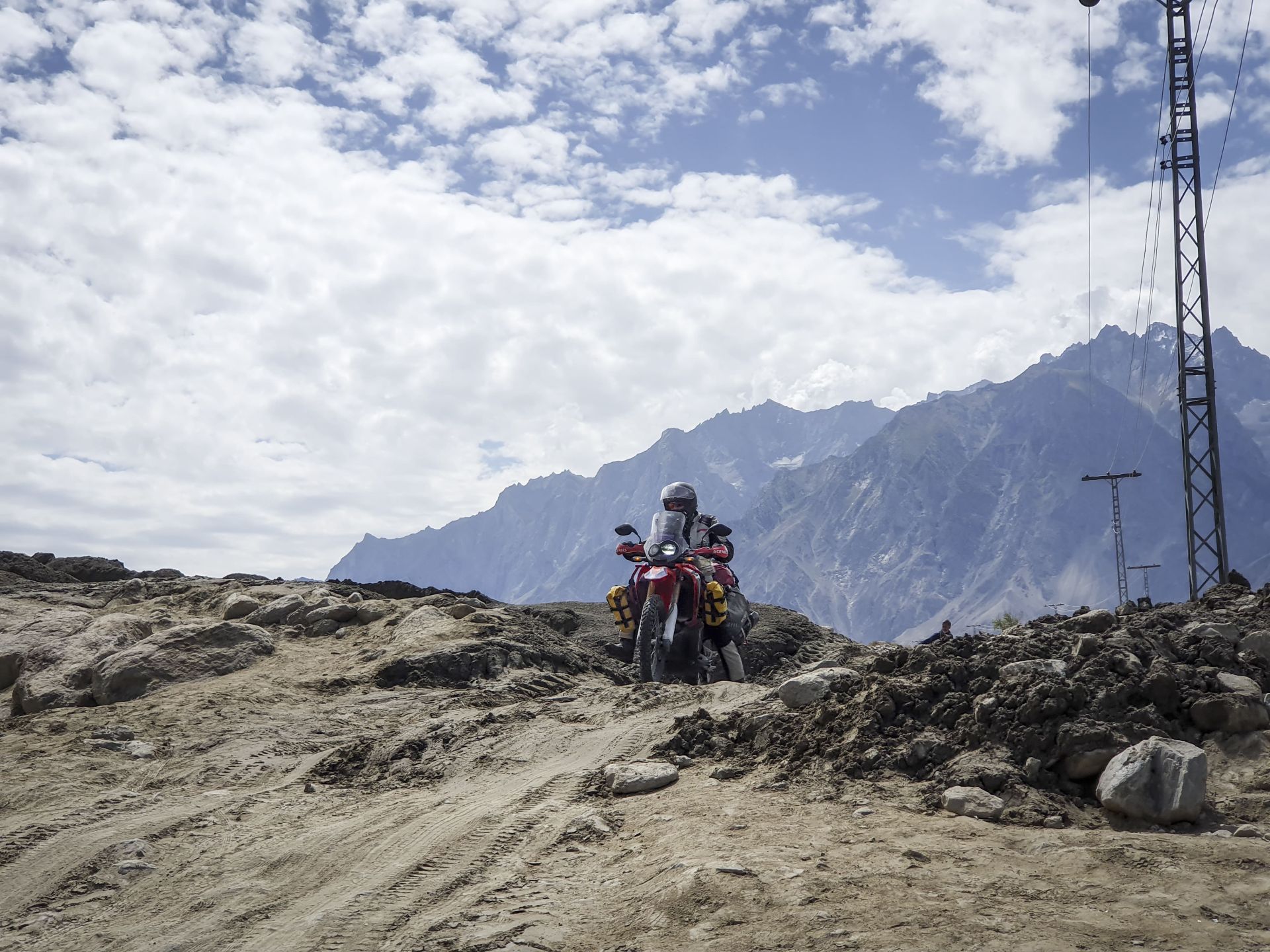
As usual, I lead the pack. The road consists of potholed tarmac for the lowest bit, then the offroad and the hairpin bends start. Up we ride, higher and higher. One hour, two, just us in the barren mountains. But then I spot what I dread most: a steep, uphill track clinging to the rock wall, with big, loose boulders. As if to add to my fear, clouds come in, casting a dramatic light on the setting. I halt, so do Gaea and Johanna. My friends take over the lead. They ride off, standing on the pegs, elegantly picking the best bits. ‘I can do this too,’ I mutter, ‘it’s all between the ears.’ I open the throttle.
Soon the track flattens out, it gets easier, we are reaching the edge of the climb. A grin. A jubilant shout. One last corner, and there it is, a plateau as far as the eye can see. Majestic. A 360° undulating landscape edged by distant snow-capped mountains. And a couple of tea stalls, local vendors, guides, drivers, and jeeps. No other tourists in sight, just us, beaming with pride.
Lost with purpose
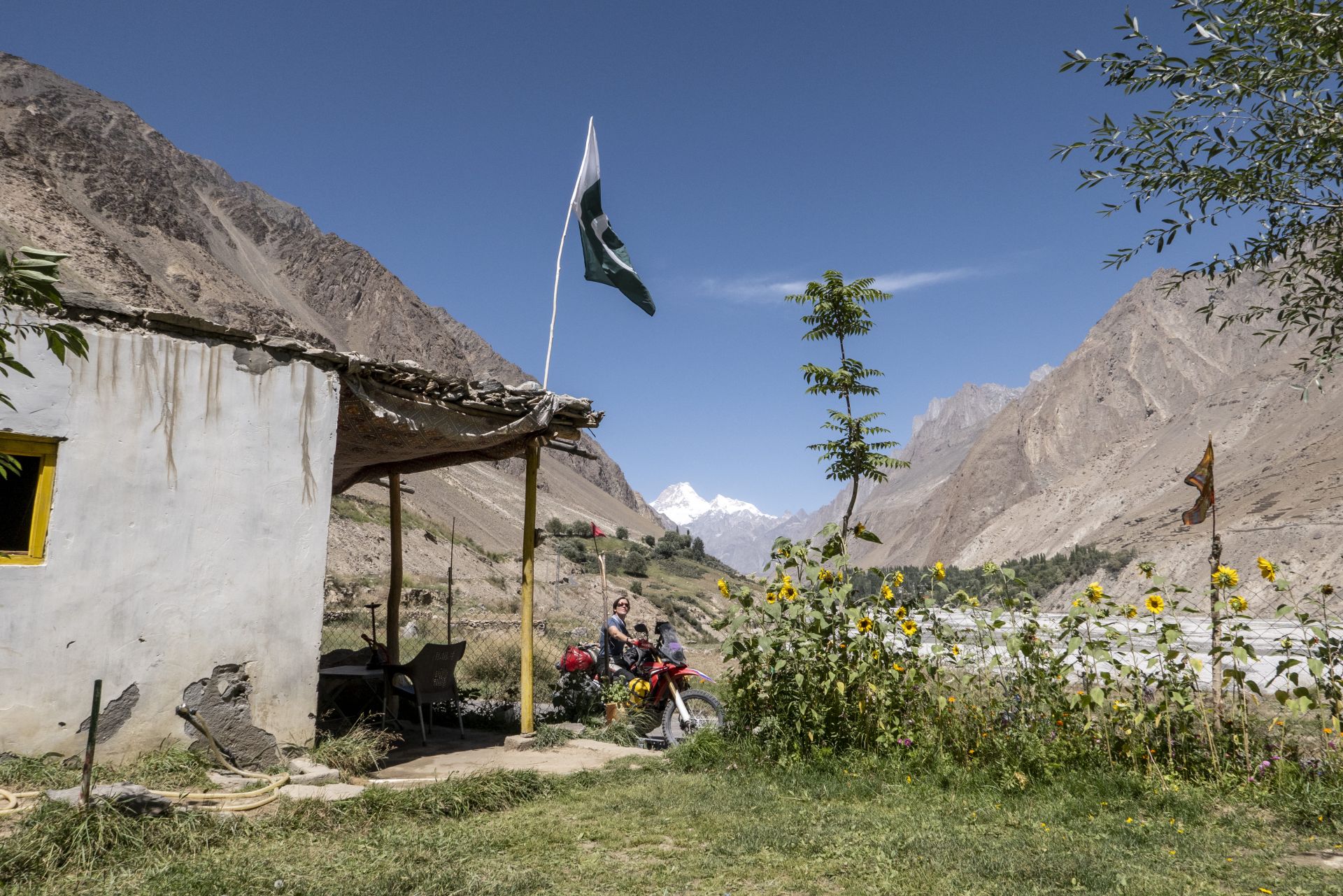
As things around us often change overnight, we take our planning day by day. One evening, Gaea proposes to go and visit Alex ‘lost with purpose’ Reynolds, a world travelling motorbiker who lives in Pakistan and runs the guesthouse Coyote Den in the Ishkoman valley. ‘You could also make her portraits and interview her for your book ‘Trailblazers’,’ Gaea adds. I’m all for discovering this lesser-known side valley, sure, but I’m not keen on adding a famous influencer in my book, the likes who mainly hail themselves. Until I dive into her blog that is. I can’t stop reading. I read ALL of it.
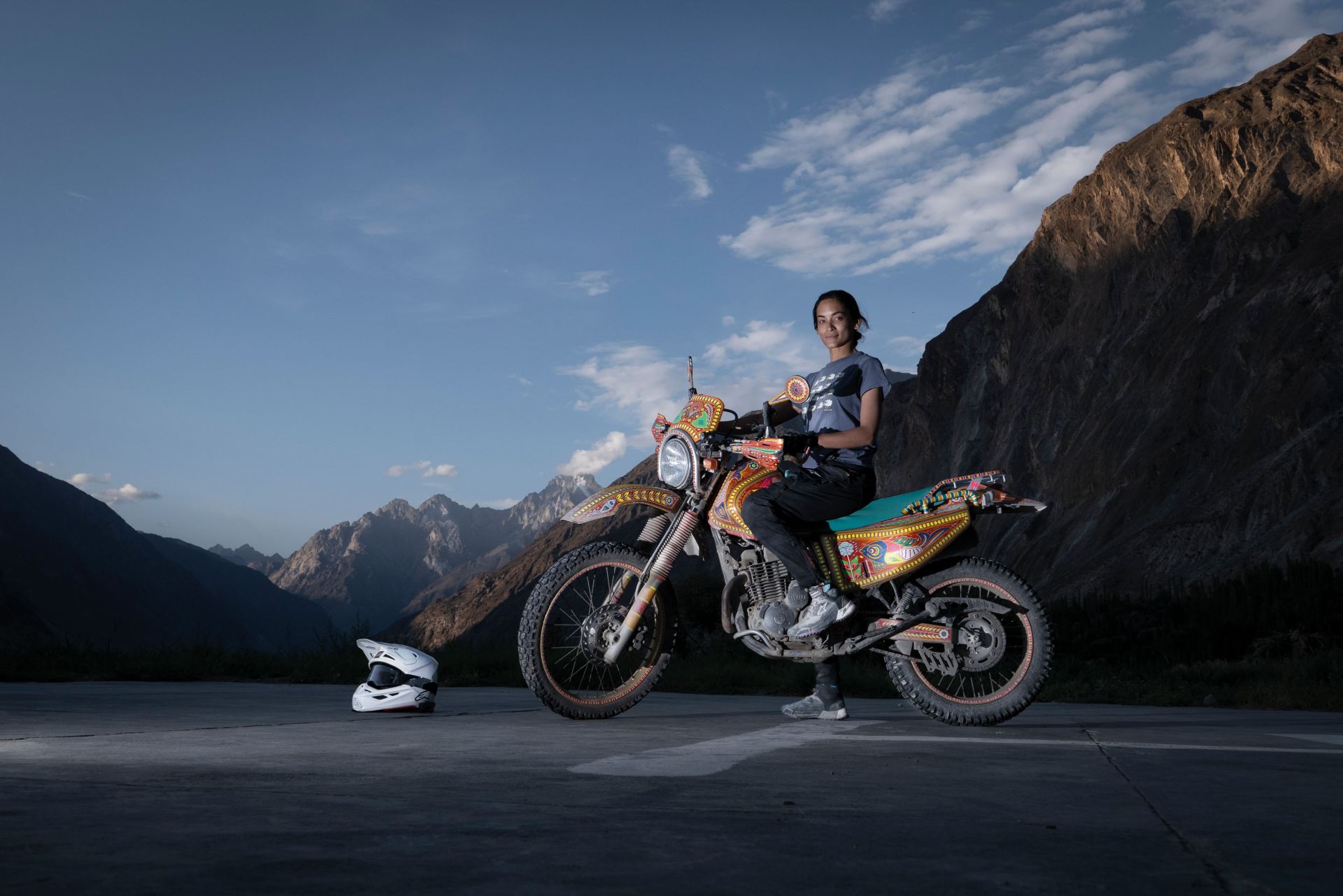
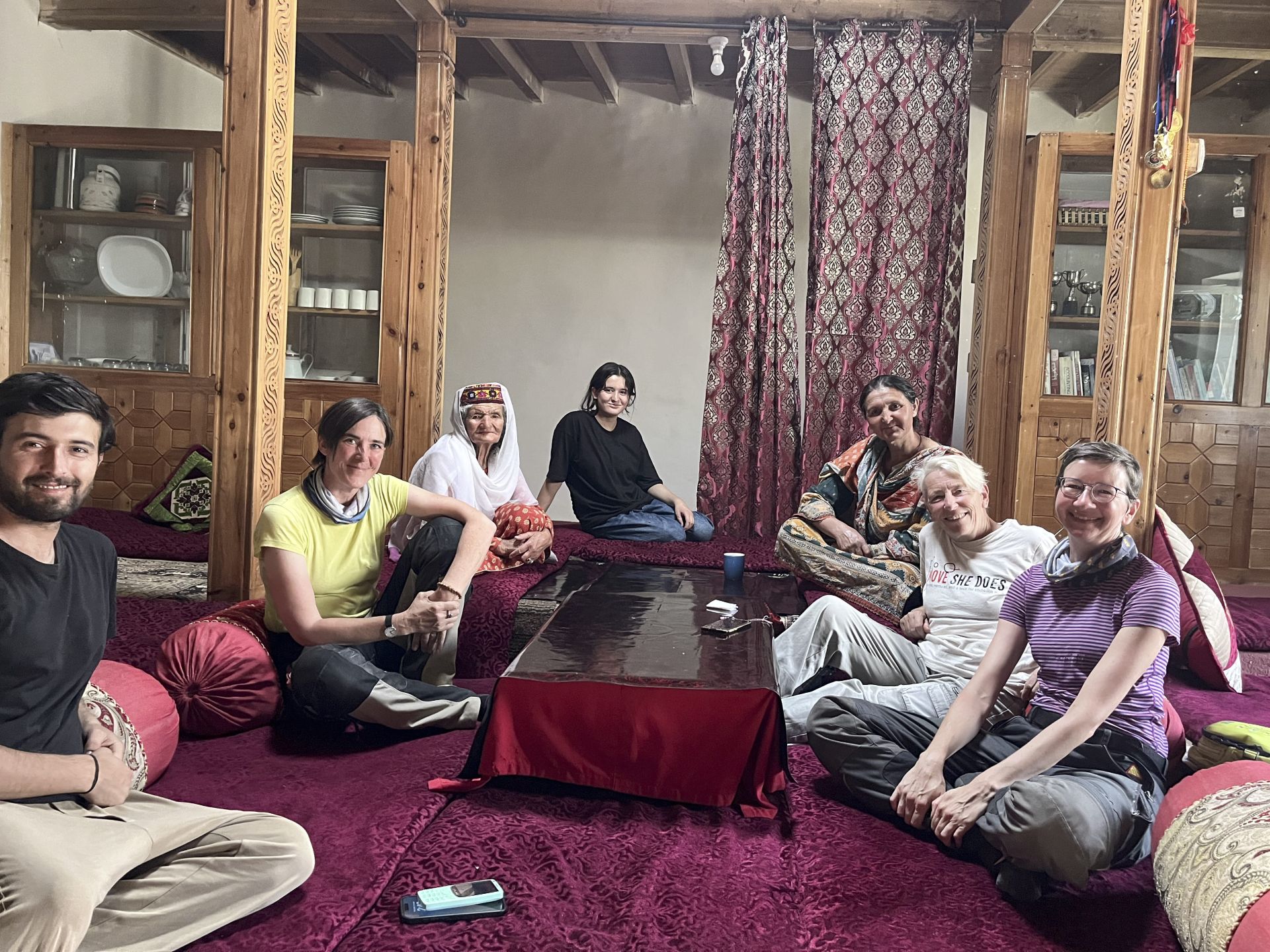
After yet another glorious riding day, we arrive at the guesthouse, settle into our spacious room overlooking the garden, say hello to the old horse, and join Alex and her business partner Sana for a homemade dinner. They talk about the disaster in Dain, the village right across from the guesthouse at the other side of the river.
Two weeks ago, on 14 August 2025, an unprecedented cloudburst broke over the Ishkoman valley. Dain was hit hardest. Two people lost their lives in the resulting landslide, livestock was swept away, as were dozens of houses, shops, fields, orchards, electricity pylons, and irrigation and drinking water channels. The swollen river washed away the 200-metre-long suspension bridge. 5,000 residents were cut off from the rest of the valley.
The following day, to even reach the bottom end of the village, Alex and Sana had to take a 15-kilometre detour. The stench of carcasses that met them was unbearable. Chunks of concrete, twisted metal, and deep mud everywhere. The only road leading uphill through the village had completely vanished. The residents were at their wits’ end.
Alex and Sana rolled up their sleeves to help. The most urgent task: repairing the road. Using their own money supplemented by a crowdfunding campaign, they hired an excavator with an operator.
This is what climate change means in very real terms for the people who live here. Climate change for which the industrialized world is primarily responsible. Sure, the erosion is partly caused by felling trees, and people are working hard to change the mentality and to plant trees, but those few trees don’t stop the melting glaciers. Pakistan’s over 7,000 glaciers, more than anywhere outside the polar regions, are all at risk. These glaciers are critical for agriculture, hydropower, and 75 percent of the stored-water supply for its 250 million people.
‘Just a little bit of off-road,’ says Alex as she takes us to see the work in progress. We have to give it our all to keep up with her. There’re the spiciest kilometres we’ve ever ridden.


To cross or not to cross
By now it has become clear that the Wagah border for India will not open. Gaea and Johanna decide to ride to Tajikistan, via China again in three days, then on to Kyrgyzstan from where they will fly home and ship their bikes the same way as they came.

Back in Passu, a new hurdle has risen. Protesters have been blockading all border trade between Pakistan and China for over fifty days. Reason in short: Gilgit-Baltistan (the entire North) has no representation in parliament, yet the people must pay taxes. They demand to become tax-free zone for trade. Up to a few days ago, they let foreign travellers pass in and out of the country, but to increase pressure on the government, they now blockade foreigners too. Suddenly passport privilege does not work anymore.
Another waiting begins. Maybe Monday. Just maybe. A sliver of hope mixed with frustration. After days, the message comes that the border opens for one day only. We race to Sost. People and customs officers run to and fro. A bustling mayhem. A mere two hours later all paperwork for the girls is done. A quick tea and chapattis, and off we ride to the border on the Khunjerab Pass.

I park in front of the last barrier and walk; my friends ride on to the fence. Then all goes quickly. Hugs, photo’s, a small present, wishes, photo’s, last hugs, waving. The Chinese open their gate and grimly summon their papers. The Pakistani border guard lets me walk up to the Chinese fence in no-man’s-land for a last goodbye. Then they disappear for the long road to Tashkurgan.
I walk back, sit for a bit, start the bike and ride. First slowly, thinking, absorbing the breath-taking mountains. Then I realise I don’t have much daylight left to reach Passu and open the throttle. Just before dusk, I arrive at the lodge, for a hot shower, a lone dinner and ditto boots at “our” door. Day for day one month of Pakistan together. Memorable in so many ways. Their journey goes on, as does mine for a little while.



Text: Gaea Schoeters & Trui Hanoulle
Images: Gaea Schoeters, Trui Hanoulle & Johanna Zimmer
To know more about Gaea Schoeters go to:
https://www.instagram.com/gaeaschoeters
To know more about Trui Hanoulle go to:
https://www.polarsteps.com/TruiHanoulle
https://www.instagram.com/truihanoulle
#FORYOURRIDINGPLEASUREONLY